




For decades, the phrase “POA” (Price on Application) has been a familiar feature of boat listings. Whether browsing luxury superyachts, new production vessels or brokerage listings, buyers frequently encounter boats advertised without a visible price.
However, as regulators increase scrutiny of pricing transparency across a range of sectors and consumer expectations continue to evolve, the marine industry may need to reconsider whether hidden pricing remains aligned with the needs of today’s buyers.
In recent years, UK regulators have challenged the use of POA in the property market, arguing that withholding pricing information can prevent consumers from making informed decisions. At the same time, growing emphasis has been placed on greater transparency across online marketplaces. Against this backdrop, the continued use of POA in the marine sector warrants renewed discussion.
The changing consumer landscape
Today’s buyers are more informed than ever. Before speaking to a salesperson, many have already researched products online, compared specifications, read reviews and established realistic budgets. Price forms a critical part of that decision-making process.
The debate is already gaining traction in other sectors. In the UK property market, the National Trading Standards Estate and Letting Agency Team (NTSELAT), working alongside the Competition and Markets Authority (CMA), has previously raised concerns that the use of POA can be misleading because it withholds information consumers need to make informed decisions.
While the marine industry operates under very different market conditions, the direction of travel across many consumer-facing industries is clear: transparency is increasingly becoming the expectation rather than the exception.
 Richard Roberts, CEO and Founder of TheYachtMarket.com, said: “The marine industry cannot afford to lag behind sectors that have already embraced open, data-driven markets. Displaying at least a base price doesn’t limit customisation or negotiation; it simply empowers buyers to engage with clarity. The future of boat sales will belong to the businesses that make it easier, not harder, for people to buy.”
Why POA became popular
There are legitimate reasons why POA remains common within the marine industry. In the new boat market, pricing can vary significantly depending on engine choices, electronics packages, interior finishes, optional equipment, delivery costs and other customisation options. For larger yachts, two apparently identical models may differ in price by hundreds of thousands of pounds depending on specification.
Some brokerage sellers also prefer discretion when marketing high-value vessels, while POA can help brokers qualify enquiries and tailor discussions around individual requirements. These advantages, however, must be weighed against the potential drawbacks.
The hidden costs of hidden prices
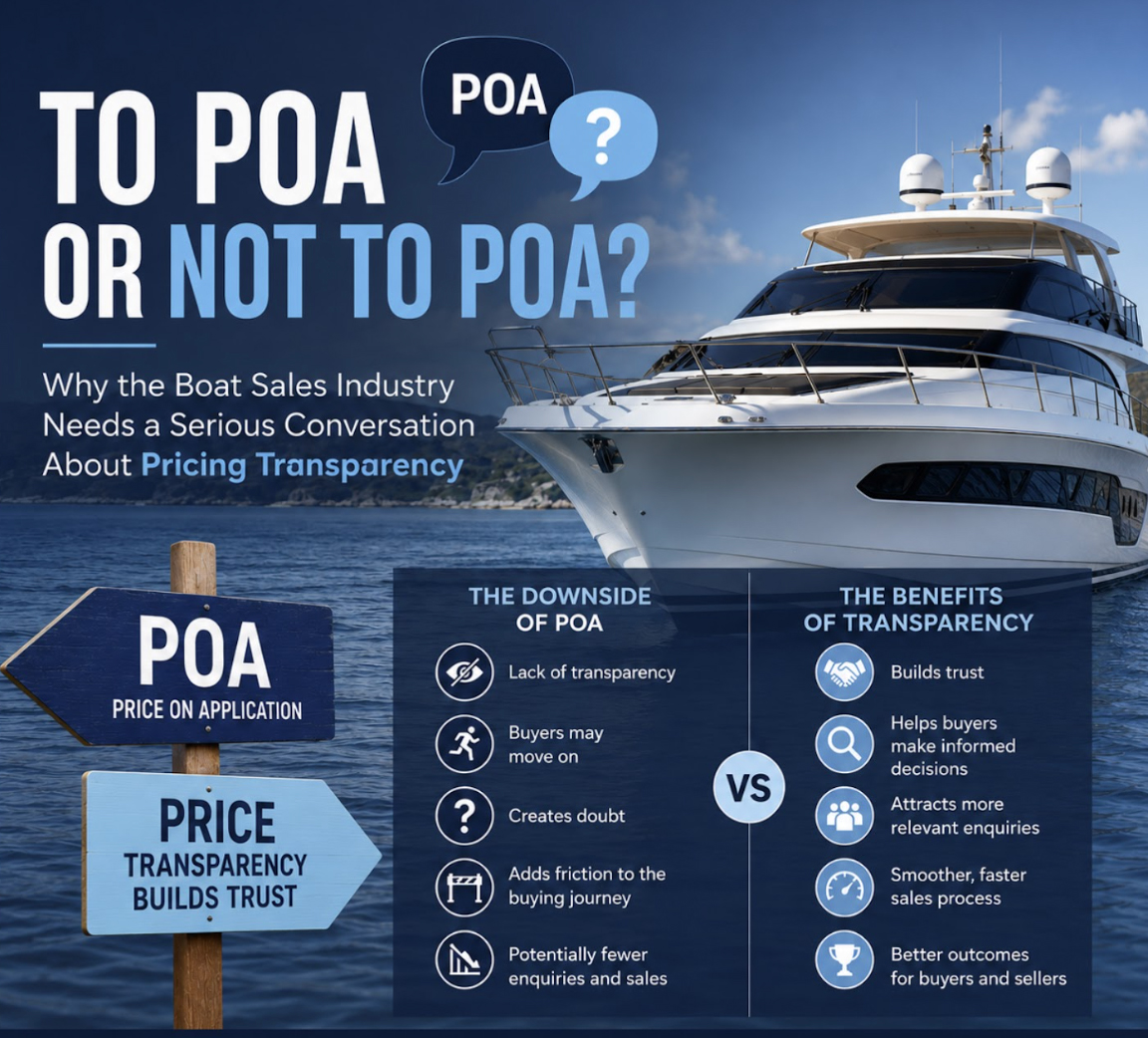
One of the primary challenges associated with POA is the uncertainty it creates. Buyers may question why pricing is unavailable, assume a vessel is beyond their budget or anticipate a lengthy sales process simply to obtain basic information. In a marketplace where competing products are only a click away, additional barriers can result in lost opportunities.
Buyers are naturally more likely to engage with listings that provide clear pricing information. Listings without prices may also be excluded from searches using price filters, reducing visibility. For many consumers, transparent pricing builds trust, while hidden pricing can create doubt.
The new boat market: A better alternative?
Manufacturers and dealers often present the strongest case for POA because final pricing can vary substantially according to customer specification.
However, while the final purchase price may differ, every model begins with a standard configuration. Publishing a base price alongside a clear explanation that optional upgrades and customisation packages are available would provide buyers with a realistic starting point while maintaining flexibility.
Consumers are increasingly accustomed to configuring products online and receiving indicative pricing before making contact. Providing a base price does not restrict customisation; it simply enables buyers to assess affordability before entering the sales process.
The brokerage market faces similar challenges
The case for displaying prices may be even stronger in the brokerage market. Unlike new boats, brokerage vessels already exist in a defined specification and sellers typically have a clear asking price.
By withholding that information, brokers may inadvertently reduce the pool of potential buyers. Some may assume the vessel is beyond their budget, while others may be discouraged by the perceived lack of transparency.
The administrative burden nobody talks about
POA can also create additional workload for sales teams. Enquiries that could be addressed instantly through a listing instead require direct responses from brokers, dealers or manufacturers.
This increases administrative demands while potentially slowing the buyer journey. Visible pricing allows sales professionals to spend less time discussing affordability and more time focusing on product suitability and customer requirements.
 Richard Pullen, Head of Sales at TheYachtMarket.com, said: “Every day we see buyers bypass POA listings because they assume the price is out of reach or that the buying process will be more complicated than it needs to be. Greater price transparency helps attract more engaged enquiries, speeds up conversations and makes it easier for brokers, dealers and buyers to move forward with confidence.”
Consumer expectations are changing
Across almost every industry, pricing transparency is becoming standard practice. Property listings, vehicle marketplaces and luxury watch retailers now display prices or provide pricing guidance.
This shift is not being driven solely by consumer preference. Regulators and industry bodies are placing greater emphasis on ensuring consumers have access to the information needed to make informed purchasing decisions.
Consumers increasingly expect access to this information before making contact, and the marine industry is unlikely to remain immune from these changing expectations.
The debate we need to have
There will always be circumstances where POA remains appropriate, particularly for highly customised superyachts, confidential transactions, fleet sales and other specialist arrangements.
However, these situations are increasingly the exception rather than the rule. For many boats, there is a meaningful price point that could be displayed, even if only as a base price.
The question facing the marine industry is no longer simply whether POA remains useful in certain circumstances. It is whether a practice that has long been accepted continues to align with the expectations of modern buyers and the wider direction of travel towards greater pricing transparency.
As online boat sales continue to evolve, the conversation around transparency, customer experience and accessibility is likely to become increasingly difficult to ignore.