






Sailing has long been a sport that is far easier to take part in than to watch. Now, three Swedish innovators are determined to change that using AI, smartphones and a new technology that will make its debut at the 2026 Team Racing World Championship in Stockholm.
How do you make a sport engaging when spectators can barely see what’s happening?
It’s a question Martin Alsén has been asking himself for years. As a competitive sailor, he knows just how dramatic a race can be. Every tack, every wind shift, and every tactical decision can determine the outcome. But for spectators watching from shore, much of that drama is invisible.
“Sailing is an incredible sport to participate in, but one of the most difficult sports to watch,” he says.
Now he believes he has found a solution.
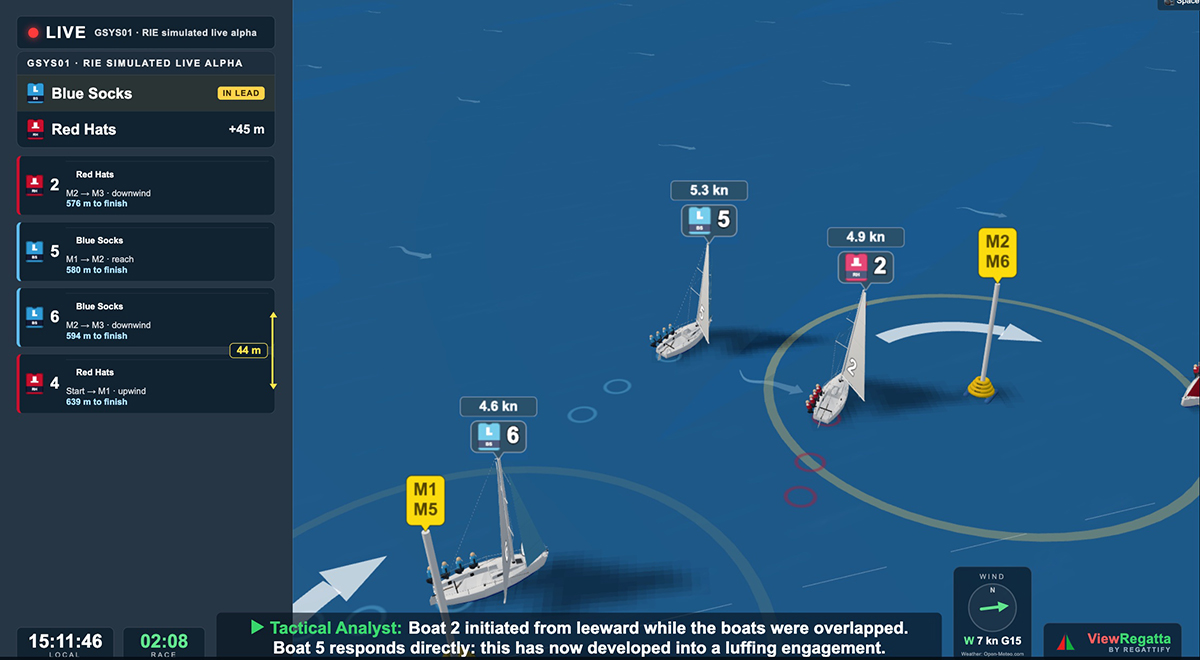
 During the Team Racing World Championship on Stockholm’s Riddarfjärden, the new platform ViewRegatta will make its public debut. Combining smartphones, real-time data, 3D visualisation and artificial intelligence, the system is designed to make competitive sailing easier to understand, more exciting to follow and accessible to a much wider audience.
The technology has been developed by the Swedish start-up Regattify, founded by Martin Alsén together with telemetry experts Ulf Ekstedt and Cindy Han. But the story began long before the company itself.
For years, Alsén has been fascinated by the contrast between experiencing a race on board a boat and watching it from land.
Sailors immediately recognise wind shifts, tactical manoeuvres and costly mistakes. Spectators, on the other hand, often see little more than a handful of boats scattered across the water.
“We’ve never really had a good way of telling the story of a sailing race,” he says.
That was the story he wanted to tell.
The inspiration came from the 2013 America’s Cup in San Francisco, where sailing broadcasts were transformed almost overnight. For the first time, advanced sensors, GPS tracking, helicopters, onboard cameras and live graphics allowed viewers to understand what was happening on the racecourse. Suddenly, sailing became accessible even to people who had never set foot on a sailboat.
The problem was the price.
The technology costs millions of dollars and remains exclusive to the world’s biggest sailing events, such as the America’s Cup and SailGP.
“They produce television broadcasts without really having to worry about the cost. We asked ourselves a different question: could we create something similar that ordinary sailing clubs could actually afford?”
The answer turned out to be surprisingly simple.
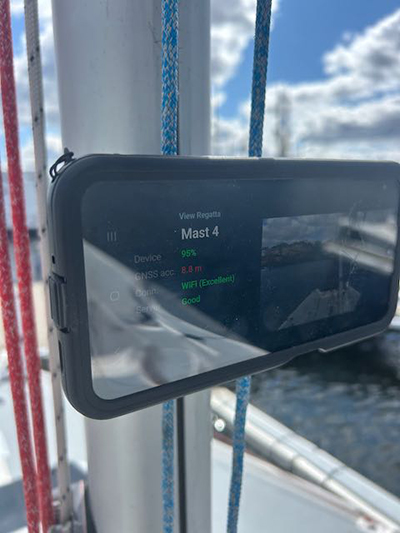
Instead of custom-built sensors, ordinary smartphones are mounted on each boat. Equipped with GPS, compass, gyroscopes, accelerometers, cameras and mobile connectivity, they already contain everything needed to capture and transmit live performance data.
The system then creates a digital twin of the race.
Spectators can follow the boats in real time, viewing speed, positioning, tactical decisions and wind conditions while simultaneously watching live onboard video.
The result resembles the television experience of the America’s Cup—but at a fraction of the cost.
“We believe we can deliver 80 to 90 per cent of that experience at a price that local sailing clubs can actually afford,” says Alsén.
The real breakthrough, however, is not the graphics.
It’s the AI.
Regattify is developing an artificial intelligence capable of analysing races using the Racing Rules of Sailing, live boat positions and tactical situations.
The ambition is for the AI not only to describe what is happening, but to explain why it is happening—and even predict what is likely to happen next.
“Our goal is for our AI commentators to be ten times better than human commentators. A machine doesn’t miss the important tactical situations,” says Alsén.
For newcomers to the sport, that could make the difference between simply watching boats cross paths and truly understanding the drama unfolding on the water.
Despite the advanced technology, the project has grown far from Silicon Valley.
Alsén jokingly describes it as his “retirement project”. A former aerospace engineer and technology entrepreneur, he joined forces with two specialists in geolocation and telemetry who have applied their expertise to competitive sailing.
Development has taken place alongside their regular day jobs.
“We’re practically working full-time on this as well. My colleagues have barely slept for the past two months,” he says.
The Team Racing World Championship in Stockholm will serve as the first major launch of ViewRegatta.
The fast-paced racing on Riddarfjärden, in the heart of the Swedish capital, provides the ideal setting to demonstrate the technology. Spectators will be able to watch the racing from the waterfront while following live visualisations, AI commentary and onboard video feeds.
For GSYS and Regattify, however, the project is about far more than one world championship.
If successful, the technology could enable thousands of sailing clubs around the world to produce professional-quality race coverage, attract new sponsors and make sailing far more accessible to new audiences.
Perhaps it is the beginning of something much bigger.
For the first time, advanced broadcast technology, artificial intelligence and everyday smartphones have the potential to make sailing truly understandable for the spectators the sport has struggled to reach for decades.