
As the RYA adopts a Digital First training framework, sailing schools are updating how they teach the next generation of sailors to navigate.
For commercial shipping, digital navigation has been standard practice for two decades. For leisure sailors and the training centres that teach them, the transition is only just beginning.
The RYA is updating its shorebased training syllabus to adopt what it calls a Digital First approach. Rather than teaching paper chartwork as the primary skill and treating electronics as supplementary, the framework recognises that most sailors now navigate using chartplotters, AIS, radar, and mobile apps as their primary tools. Traditional chartwork remains in the syllabus as an essential backup skill, but the emphasis has shifted.




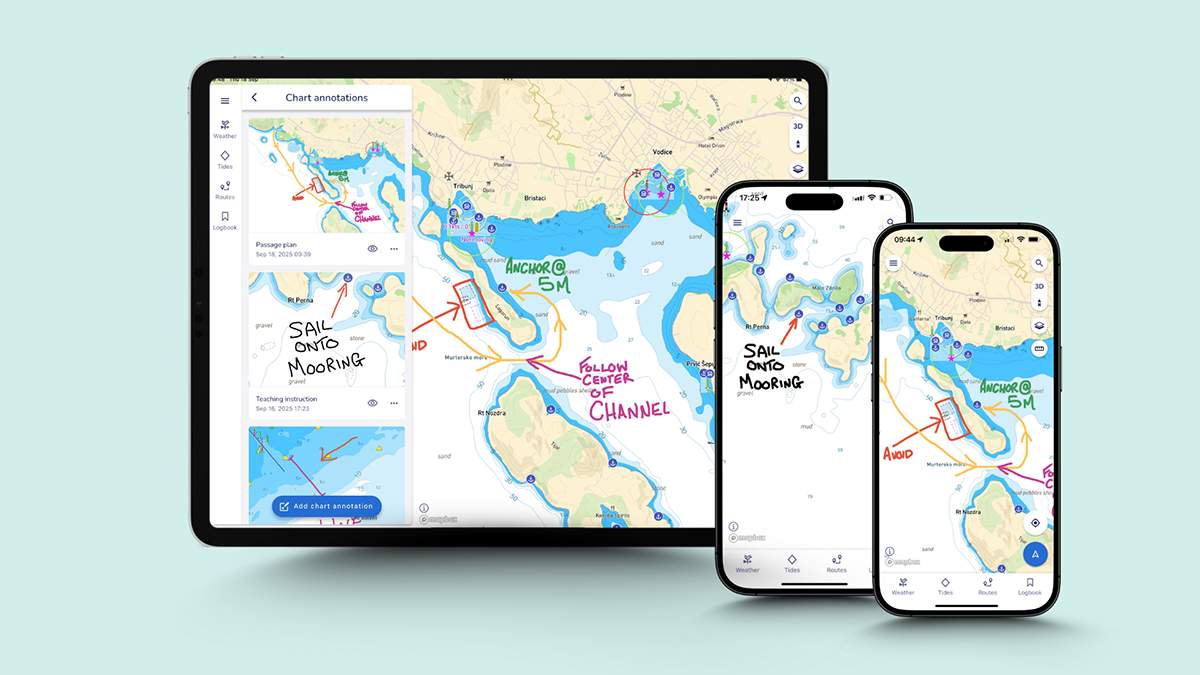
For RYA training providers, this means rethinking how courses are structured and what students spend their time learning. Passage planning now involves digital tools as a starting point. Weather routing uses GRIB files and forecast apps alongside traditional shipping forecasts. Pilotage plans might live on a waterproof tablet rather than a laminated sheet. The underlying skills are the same, but the tools have changed.
For many experienced sailors, this represents a significant shift in mindset. Generations of skippers have learned to trust a pencil line on a paper chart, and the instinct to plot a fix by hand is deeply ingrained. The UK’s Chief Inspector of Marine Accidents has noted that even in commercial shipping, where electronic chart systems have been standard for 20 years, there is still little consistency between equipment manufacturers. For leisure sailors making the transition, the challenge is not just learning new tools but developing the confidence to trust them as a primary source, while knowing when and how to cross-check with traditional methods.
Russell Lake, a member of the RYA Training Committee and Principal of Sailing Course Online, one of the UK’s established RYA-approved online theory providers, said: “The move to Digital First reflects the reality of how sailors navigate today. When someone charters a yacht in the Mediterranean or sets off across the Channel, they’re using a chartplotter and a navigation app, not plotting fixes on a paper chart. Training has to prepare people for that reality.”
Alongside the Digital First approach, however, the UK Hydrographic Office (UKHO) has commited to ensuring mariners can continue to access comprehensive, trusted and compliant charts for as long as paper charts are needed, assuring that any future changes to the paper charts portfolio will be evidence-based and in consultation with the wider maritime community.
Russell added: “That doesn’t mean paper skills become irrelevant. Electronics need power, they need a satellite signal, and they can fail. Understanding chartwork gives you a safety net. But the emphasis in training should match the emphasis on the water, and for most sailors, that’s now digital.”
Sailing Course Online, which is based at Hamble Point Marina and delivers RYA theory courses to students in over 115 countries, has updated its RYA Day Skipper theory course to reflect the new framework. The updated course includes new content on electronic navigation, digital passage planning, and the practical use of navigation software alongside traditional chartwork.
As part of the update, the provider has partnered with Savvy Navvy, the marine navigation app with over three million app downloads, to give students hands-on experience with a professional navigation tool during their studies. Students enrolling on the updated courses receive a free 7-day Savvy Navvy trial and an exclusive 20% discount.
The course content is developed and supported by RYA Yachtmaster Examiners, including Richard Beniston, one of only 22 RYA Instructor Trainers worldwide, with 23 years’ experience in professional sailing instruction.