
Licensed divers and armchair explorers alike can visit the Protected Wreck Site ofHMS Colossus, following improvements to the underwater dive trail ahead of the 2026 dive season.
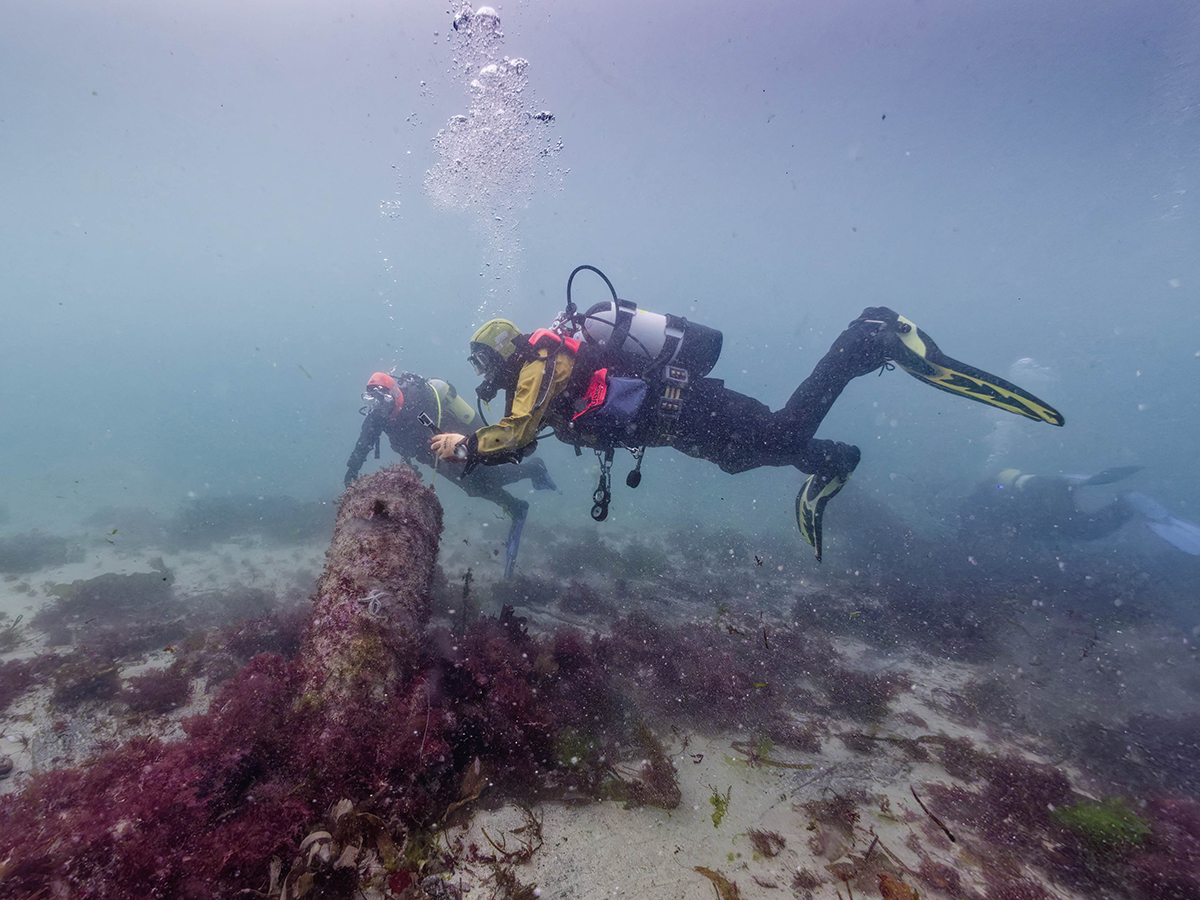
Historic England commissioned volunteer divers from Cornwall and Isles of Scilly Maritime Archaeology Society (CISMAS) to refurbish the trail, helping make the site more accessible to both visiting divers and virtual audiences. The team cleared marine growth from archaeological features, including cannons, rudder fittings and hull timbers and installed new dive stations. They also assessed the condition of the wreck site and produced new photography and video footage to showcase the wreck and its rich marine environment.
Hefin Meara, Maritime Archaeologist at Historic England, said: “The diver trail at HMS Colossus offers a great opportunity to explore the remains of an 18th-century warship, with timbers, cannons and other features still visible on the seabed. The volunteer divers from CISMAS have worked incredibly hard to improve the trail and help make this remarkable piece of England’s maritime heritage more accessible to divers and non-divers alike.”




Exploring a piece of naval history
HMS Colossus was a 74-gun Royal Navy warship built at Gravesend, Kent, in 1787. During its 11-year service, HMS Colossus saw action at Toulon, Groix, Cape St. Vincent and Cadiz. In December 1798, while sheltering from a storm off the Isles of Scilly, the ship’s anchor cable gave way and it was driven onto shallow ground off Samson, the largest uninhabited island off the southwestern tip of the Cornish peninsula. All but one of the 595 people on board were rescued. HMS Colossus later broke apart, scattering its remains across the seabed.
The ship is also known for carrying part of 18th century British diplomat and antiquarian Sir William Hamilton’s collection of ancient Greek pottery. Some 30,000 pottery fragments recovered from the wreck site are held by the British Museum.
HMS Colossus Protected Wreck Site
HMS Colossus is one of England’s 57 Protected Wreck Sites. It has been granted the highest level of protection under the Protection of Wrecks Act 1973, This means that only licenced divers can visit it. Historic England welcomes applications for licences.
Izzy Allsop, Isles of Scilly Dive Charters said: “Thanks to the efforts of the team, the dive trail has never looked better. It’s a fascinating site to dive from both marine, archaeological and ecological perspectives. I always enjoy taking divers to visit the site.”
What the diver trail offers
The refurbished trail features two circular routes taking in the major features of the wreck with numbered seabed stations and an improved waterproof guide. Clear waters, abundant marine life and well-preserved remains make the site one of England’s most rewarding heritage dives. Divers can see the remains of muskets scattered across the seabed. Cannon can be seen standing almost upright on the seabed, having crashed through the gun port when the ship turned on its side. Some of these guns are 2.75m (9 ft) long and weigh almost two tonnes each.
Kevin Camidge, Archaeologist at Cornwall and Isles of Scilly Maritime Archaeology Society (CISMAS) said: “If you only dive on one historic wreck site, make it this one. To swim along the line of cannons standing upright on the seabed with their muzzles buried in the sand, still within their gunports, is a unique experience.”
For those unable to visit in person, an interactive virtual tour mirrors the underwater trail, combining detailed 3D models, dive footage and photography to bring HMS Colossus to life.