
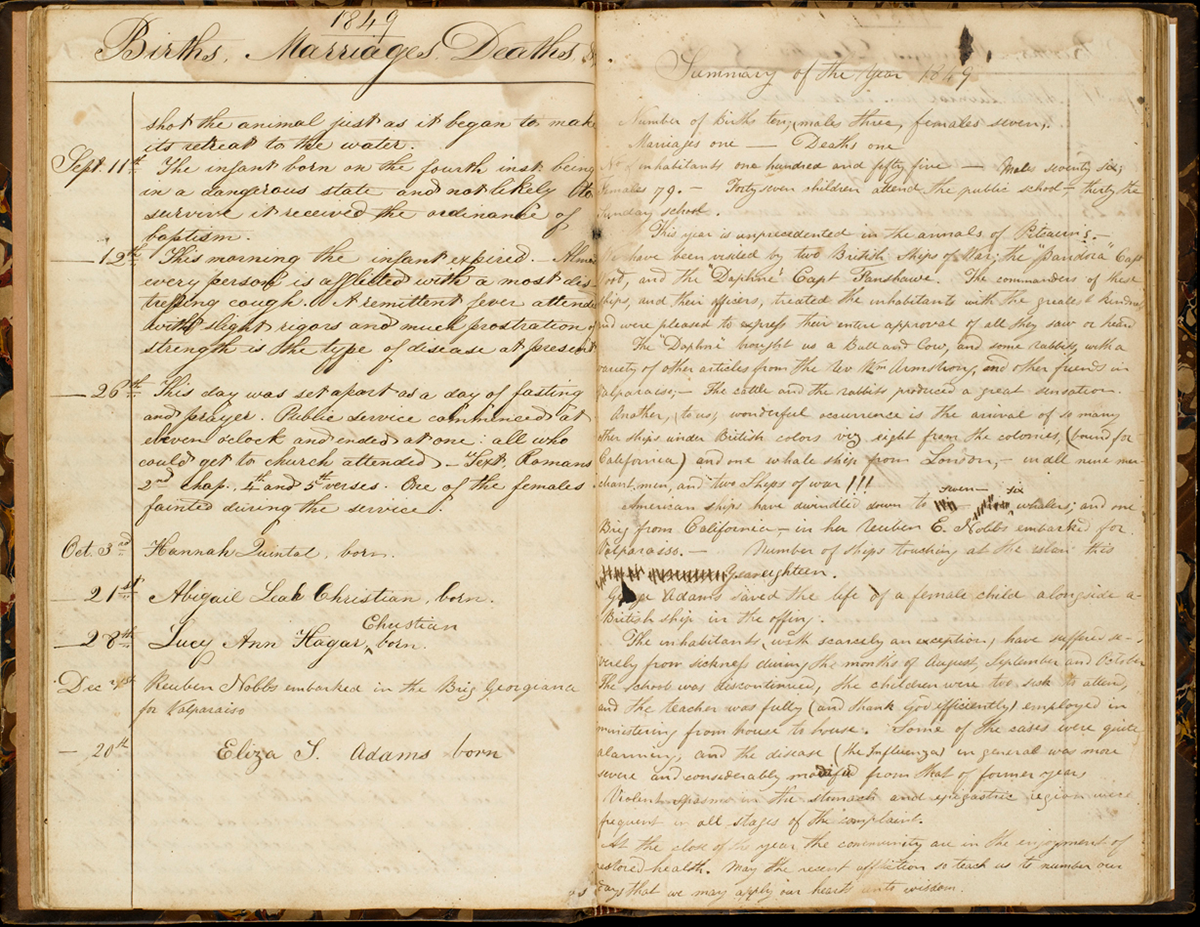
To celebrate the 170th anniversary of ‘Bounty Day’, the National Maritime Museum is loaning the Pitcairn Register to the Norfolk Island Museum Trust.
The Register is a record of the births, marriages and deaths from the burning of HMS Bounty in 1790 to 1854. Included in the Register are references to the first child born on Pitcairn – Thursday October Christian, son of lead mutineer Fletcher Christian and his Tahitian wife Mauatua.
8 June is ‘Bounty Day’ on Norfolk Island, the day that descendants of the Bounty mutineers and their Polynesian wives arrived from Pitcairn Island, where the mutineers had landed, to their new home on Norfolk Island, a remote island in the South Pacific. In 1856, Queen Victoria gifted land grants to Pitcairn Islanders after the population grew too large. Today, more than 25 percent of the population of Norfolk Island can trace its ancestry to the Bounty mutineers and their Polynesian wives – and the people listed in the Pitcairn Register. This landmark loan brings what is considered a foundational document of the community to the descendants for the first time.




Drawing on the testimony of the last surviving mutineer, John Adams, the Register documents what happened on the island. The next chapter in the Bounty story was just as violent as the mutiny had been. The Register records a ‘massacre’ among the mutineers and Polynesian men in 1793, the first distilling of alcohol on the island in 1798 and the attempted murder of Edward Young and John Adams by Matthew Quintal in 1799.
The Register also records an attempt by the Polynesian women to escape Pitcairn Island in 1794, explaining how ‘a great desire in many of the women to leave the Island’ led them to launch a boat. The author posits the question ‘what could a few ignorant women have done by themselves, drifting upon the waves, but ultimately have fallen a sacrifice to their folly’, revealing contemporary European attitudes towards women.
Helen Mears, Head of Curatorial at the National Maritime Museum said, ‘The Register is a unique historical document which testifies to the resilience and resourcefulness of the community that formed from the 9 mutineers, 6 Polynesian men, 12 Polynesian women and baby girl who landed on the Island in 1790. With the support of the Norfolk Island Museum Trust, the National Maritime Museum is delighted to enable the descendants of this community to see the volume and excited by the opportunities for further knowledge sharing and partnership.’
Dr Pauline Reynolds is the Chair of Norfolk Island Museum Trust. She is also descended from the Bounty mutineers, their Polynesian wives, and both authors of the Pitcairn Register. She said, ‘this is a foundational document of our people, it contains what we call “awas kamfram”, our origins’.
The loan of the Pitcairn Register has been generously supported by Qantas. 2027 marks 80 years since the first Qantas flights to Norfolk Island. The Australian Federal Government-awarded agreement for Qantas to provide passenger and freight connectivity to the island was recently extended until March 2028.
Lucy Cooke, Head of Development & Events at the National Maritime Museum, said, ‘We are thrilled to be partnering with Qantas and are very grateful for their contribution to ensure the safe arrival of the Pitcairn Register on Norfolk Island as part of this global collaboration.’
The Pitcairn Register will be on display for up to three years from Friday 1 May.