
As the Royal Society of Marine Artists’ (RSMA) prepares for its 81st Annual Exhibition at the Federation of British Artists’ Mall Galleries this September, new figures reveal a succession dilemma for the historic society, as an increasingly senior membership is met with a growing demand for marine art.
The Society, which showcases and champions the very best in contemporary coastal and marine art, is facing two powerful forces which raise an urgent question: how the society will engage younger artists in one of Britain’s most distinctive and in-demand artistic traditions?
As of August 2026, the society is facing a dramatic succession challenge, with 90 percent of RSMA members aged 50 or over, half (58 percent) aged over 65 and no members in the under 35 category. While this means members hold the decades of experience required to capture a moving wave accurately and beautifully – Constable famously described “that most arduous” difficulty as reason for spending decades painting clouds – it also means the Society must make attracting the next generation of marine artists a priority.





This is particularly pressing when demand for marine-focused figurative art is growing, and submissions for the RSMA Annual Exhibition (open to both members and non-members) are increasing. Artist submissions have risen by 48 percent since 2022, while annual sales have increased by 44 percent since 2022. The figures demonstrate marine art’s enduring appeal and the opportunity for young figurative artists to focus their efforts on what is a lucrative genre.
Search for a new generation of marine artists
So why is the RSMA membership currently so much older? The Federation of British Artists, which supports not only the RSMA but also the Royal Society of Portrait Painters and the Royal Institute of Oil Painters, believes a perception gap among younger artists and a reliance on seeing subject matter through a digital lens may be to blame. Capturing the sea and the sky needs to be done in person, rather than through photographs or with AI.
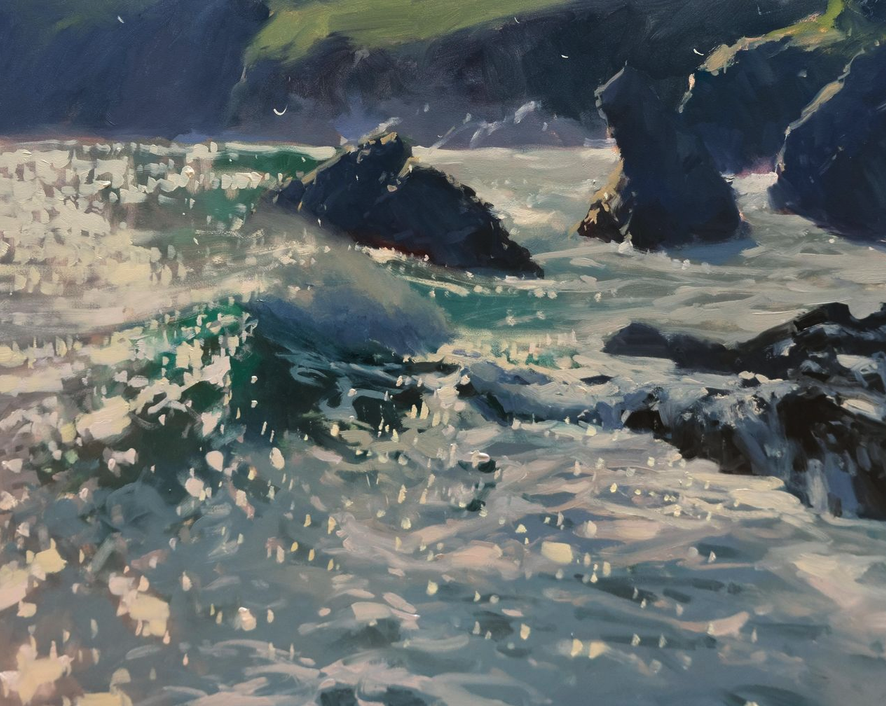
Mall Galleries Creative Director Addi Aegisdottir said: “There is a misconception that marine art begins and ends with historic galleons and familiar seaside scenes. The Annual Exhibition demonstrates something much broader and more contemporary. Painters such as Jenny Aitken show incredibly powerful sea and sky studies, and beautifully atmospheric oils which look at how light plays on the water. The level of skill is second-to-none.”
“Young figurative artists may also need more support and encouragement in the practice of painting ‘en plein air.’ Capturing waves accurately requires study over time and careful observation. With the pull of AI and photography as modern, efficient ways to capture a painting subject, younger artists may be missing the natural training ground provided by painting from life.”
Every year, the society gives a New Generation Award to an artist under 35 whose work offers a fresh, modern take on marine art. This year, London-based artist Harsh Agrawal, who changed careers after Covid following a full-time role with Disney and Pixar, won the award for his painting “The Path to Portland Bill.”
On the issue of attracting young artists, Harsh said: “When it comes to marine art, there does seem to be an established group of artists who are of retirement age. I paint beside the Thames every Wednesday with a group that has been painting since 1948! I would encourage young painters to come and see the Annual Exhibition for themselves. The quality of the painting is amazing and the work challenges what many people would consider to be traditional marine art – it is far from just boats.”
As an island nation, coastal and marine art is strongly embedded in our consciousness and is something people want to buy for their homes. Paintings of the sea and of the coast are timeless and evocative of family summer holidays and dreams of escape.
A geographically diverse community of artists is also engaging with the RSMA, stretching from London and other major cities to coastal communities including Penzance, Newlyn, Falmouth, Brighton, Ramsgate, Torquay, Ilfracombe, Morecambe and North Berwick.
More than one in four artists on the Society’s non-member list submitting work to the Annual Exhibition this year lives in an identifiable coastal location. With more people moving out of cities and towns since the pandemic, the normalcy of remote working, and now the cost of living, there may be more artists, and would-be artists, starting to live within proximity of the sea.
Jenny Aitken, another RSMA member says the interest in marine art can be seen on social media; “There is a swell of interest for marine art, unlimited to any particular age group or country. I see this in the response to my marine work both on social media and in galleries. My most popular type of work, by far, is that showcasing the ‘sparkly light on the sea.’
“Perhaps marine art can still be seen as old-fashioned, but I think it’s a rich and wonderful subject for younger artists to explore. There’s definitely a strong and growing market for it.”
A natural artistic training ground
Marine art is representational in its broadest sense and includes painting, sculpture, printmaking, drawing, textiles and mixed media. What unites the work is an engagement with the sea and tidal waters – and the considerable challenge of capturing subjects that rarely remain still.
Accurately observing waves, reflections, weather and rapidly changing light requires patience, repeated study and technical confidence. The RSMA believes this makes marine art a valuable training ground for artists at a time when photography and artificial intelligence offer increasingly immediate ways to generate and reproduce images.
Nicholas St John Rosse RSMA President said; “Working directly from the natural world has perhaps never been more valuable than within the genre of marine art. Painting water and changing light demands careful observation, judgement and persistence.
“Those skills cannot be acquired through shortcuts. By encouraging younger artists to work from life and engage directly with the marine environment, we can help preserve important artistic knowledge while allowing the genre to develop in new and unexpected directions. The persistence required is also needed in the pursuit of RSMA membership. It takes time for artists to create work, submit it and then exhibit – the elapsing of time is a necessary step in maintaining the society’s pursuit of excellence in marine art.”
The RSMA 2026 Annual Exhibition
The Royal Society of Marine Artists Annual Exhibition is widely recognised as one of the UK’s leading showcases of contemporary marine art. Taking place at Mall Galleries from 16 to 26 September, the exhibition will present work by RSMA members alongside new talent selected through an open submission.
Subjects range from deep-water shipping and competitive sailing to quiet harbours, coastal landscapes, marine wildlife, still life and contemporary interpretations of the sea. All exhibiting works are available to purchase.
This year, Sally Kettle, the first woman to row the Atlantic Ocean twice from East to West, will be opening the exhibition.
Royal Society of Marine Artists Annual Exhibition 2026
MALL GALLERIES, LONDON: 16 – 26 September
Time: 10am – 5pm
Admission: £7 (Free for Friends of Mall Galleries and under 25s, concessions available). No booking required