115 Days Solo, over 2,000 Nautical Miles, One Purpose.
A solo circumnavigation of Great Britain for Alzheimer’s Research UK
By Paul Smith
 There are probably easier ways to raise money for charity than spending 115 days sailing single-handed around Britain and Ireland. But, looking back, I am not sure any of them would have given me quite the same experience.
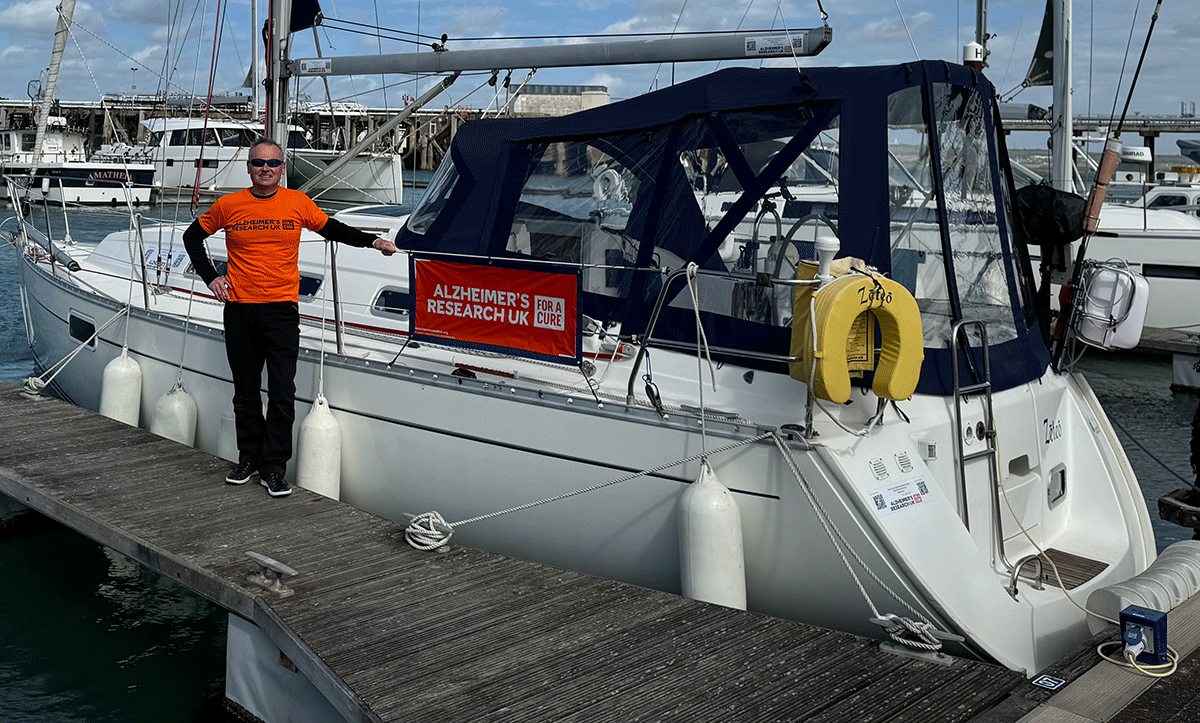
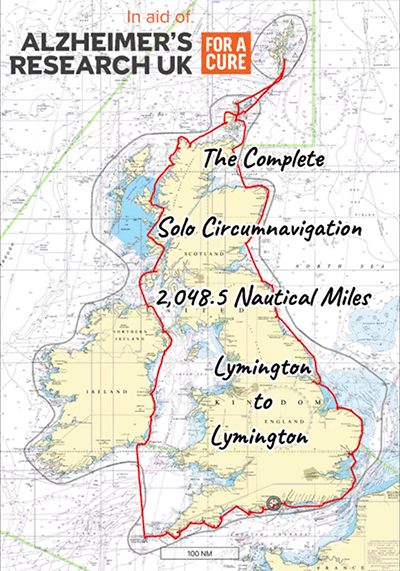
On 11 April 2026 I slipped my lines at Lymington Yacht Haven aboard my 1998 Beneteau Oceanis 321, Zēteō, to begin a solo circumnavigation of Britain and Ireland. Ahead lay more than 2,000 nautical miles of coastline, some of the most challenging tidal waters around these islands, long days alone at sea, numerous unfamiliar harbours and, inevitably, a few occasions when I wondered precisely why I had thought this was such a good idea.




The purpose behind it, however, was much more important than the sailing – I was raising money for Alzheimer’s Research UK.
Why Alzheimer’s Research?
Throughout my professional life as a Charted Financial Planner, I had spent many years helping people prepare financially for retirement as well as encouraging them to create a detailed plan of all the meaningful activities they wished to undertake in retirement. However, what I began to witness was something far more sobering: clients reaching the retirement they had worked and planned hard for over many years – sometimes decades – only for those plans to be devastated and ‘stolen’ from them by a diagnosis of dementia.
The financial consequences can be enormous, but they are almost secondary to what the disease does to the person and to the people around them. Watching somebody you love gradually disappear, day by day, piece by piece, while still physically being there is extraordinarily cruel.
When I retired I wanted to do something difficult enough that people might notice – and hopefully, be persuaded to put their hands in their pockets to help find a cure. That was the motivation behind the voyage.
My original fundraising ambitions were considerably more modest than where the campaign eventually took me. By the time I completed the circumnavigation, the generosity of former clients, friends, family, fellow sailors, complete strangers and people following the voyage online, had taken the fundraising total (including Gift Aid) beyond £12,500.
There is now one final hurdle to complete this mission: To reach my fund raising target of £15,000 for Alzheimer’s Research UK. (£15,000 is not an arbitrary figure, it is the amount it costs to train a PhD Student for 1 year in order to develop the requisite skills they will need to support the research team).
Best Laid Plans & Sailing
After many a night through the winter months of plotting and planning my circumnavigation, these plans were consigned to the bin on the very first day! A planned first leg from Lymington to Brighton was dramatically curtailed by impending 40 knots of wind of and 3 metre Seas following a very foggy early morning departure – so Gosport became the first port of call.
Anticlockwise from Lymington
I chose to sail anticlockwise, from my home port of Lymington, the first passages took me east along the south coast, through the Dover Strait and into the North Sea. Almost immediately, the voyage became an education in just how different single-handed coastal sailing is from an ordinary weekend cruise.
When you are alone, everything is your responsibility; Navigation, pilotage, sails, engine, weather, tides, cooking, communications and maintenance all belong to the same department – you.
There is nobody coming on watch in four hours, in fact when conditions were too much for my autopilot there was no-one to take the Helm even for a few minutes (this can make life uncomfortable for those of us with an enlarged prostate). There is nobody down below making tea and when something goes wrong, there is nobody to look at and say, “What do you think?” You already know who has to sort it out.
From Dover I continued north through the waters of the Thames Estuary in pea soup foggy conditions and up the east coast, calling at places including Shotley, Lowestoft, Grimsby, Whitby and North Shields before continuing towards Scotland.
These waters also provided an early reminder that a circumnavigation of Britain is not simply a matter of following the coastline. The journey is punctuated by tidal gates, Get them right and the sea helps you, get them badly wrong and several knots of tide can turn a straightforward passage into a very long day indeed. Flamborough Head, the waters off the north-east coast, Rattray Head, the Pentland Firth and Cape Wrath were among the names that occupied an increasingly large part of my passage planning.
And then, of course, there was the weather.
The further north I went, the bigger it became
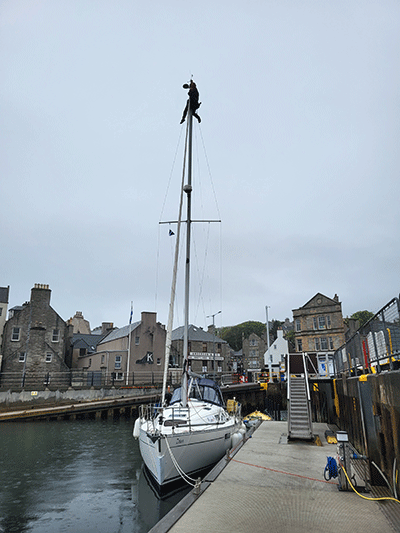
There is something very different about arriving somewhere by sea. A headland that is simply a name on a road map becomes enormously significant when you have spent hours working your way towards it and ultimately around it.
Scotland provided some of the most spectacular moments of the entire voyage.
As Zēteō worked her way north, the coastline became wilder and the distances between comfortable stopping places more significant.
Eventually came the Orkney Islands (and a flare up of Gout, even before I tucked into a freshly caught lobster given to me on Westray by Colin & Lynn two of the most hospitable people you could ever wish to meet). Then onto a Fogbound Shetland with no Wind Instruments working, before coming back via Stronsay and Stromness, followed by one of the passages I had thought about long before leaving home: heading out through Hoy Sound, across Scotland’s exposed northern waters and towards Loch Eriboll.
Then came Cape Wrath. Even its name sounds as though it was invented specifically to make sailors reconsider their life choices.
For a single-handed yachtsman in a 32-foot cruising boat, rounding the north-western corner of mainland Britain was one of those occasions when preparation, weather and tide all had to come together. It was also a milestone, I was no longer sailing north, I had turned the corner.
Down the wild side
The north west coast of Scotland brought a different Britain altogether. The scenery was magnificent, often remote and occasionally intimidating.
Long passages alternated with extraordinary anchorages and harbours. There were days when sailing alone felt like the greatest privilege imaginable: Zēteō moving through beautiful empty water, the coastline unfolding ahead and the satisfaction of knowing that every mile was taking me further around this beautiful country under my own steam.
There were other days when single-handed sailing felt rather less romantic.
Fatigue accumulates.
A small problem on a crewed boat can become a significant problem when you are alone. Something as mundane as needing to go below becomes a tactical decision when the boat is moving quickly in awkward conditions. And the sea has an excellent habit of exposing any complacency.
One of the lessons of the voyage was that single-handed sailing is not necessarily about being brave – It is about trying not to create situations in which bravery becomes necessary. Reef early, Plan ahead, Keep things simple, Know where you can stop. Understand the tide, Look after the boat. And, perhaps most importantly, know when not to go – you have zero chance of beating mother nature!
Ireland
The voyage eventually carried me across to Northern Ireland and then onwards down the East Coast of Ireland.
Places such as Ballycastle and a trip by bus to visit The Giant’s Causeway, followed by challenging passages down Ireland’s east coast gave me some of the most memorable experiences of the circumnavigation and were followed by a coastline that again demonstrated why sailing around these islands can never become monotonous.
By this stage, something else had happened too. What had begun as my voyage was no longer entirely mine. People were following Zēteō’s progress.
Through YouTube and Facebook, friends, sailors and people I had never met were travelling around the coast with me. Messages would arrive from people wanting to know where I was going next, some offered suggestions of where to visit (there were so many places to see), some offered encouragement and others simply donated.
Occasionally people appeared in harbours having followed the voyage online. That support mattered far more than I had expected. Single-handed does not necessarily mean alone.
Homeward bound
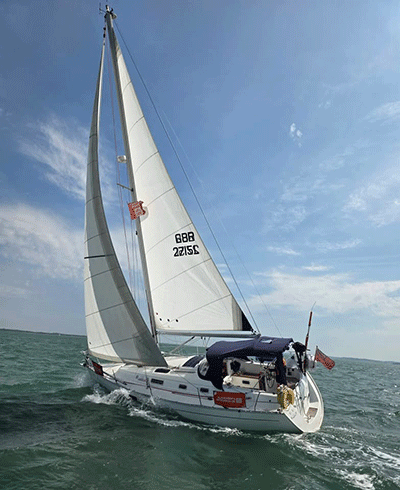 Eventually Ireland gave way to the beautiful sun-drenched Isles of Scilly which marked a dramatic change in the weather, prior to this, whilst much of the UK was basking in 30°C I was still wearing multiple layers of clothing and the Sun Tan Lotion had not been opened!
Following my 24.5 hour passage from Kilmore Quary in Ireland to the Isles of Scilly, Tresco represented familiar ground for me and meant Zēteō had completed her own circumnavigation following a trip to the Scillies the previous year. So just the ‘solo bit’ to complete then!
Finally back to familiar harbours and anchorages for the first time in months as I worked my way back home along the south-west coast – this in itself though was a double edged sword – the danger of complacency was now very real. I had to remind myself I still had to navigate past the Lizard, followed by Portland Bill and time the Needles Channel correctly to avoid embarrassment. Each was another waypoint crossed off the chart and another step towards home.
But there was a strange contradiction as Lymington grew closer. For months the objective had been to complete the circumnavigation. Now that completion was within reach, part of me did not want it to end. Life aboard had developed its own rhythm.
Wake, check the weather, check the sea state, recheck tidal constraints, check the weather again, make a decision, prepare the boat, Sail, Navigate, Arrive, Secure Zēteō, Eat, Sleep, Do it again. The world had become wonderfully simple.
There were difficult moments, certainly. There were uncomfortable seas, demanding passages, unreliable winds, fatigue, but giving up never crossed my mind , not once – the cause was too important.
But there were also moments of extraordinary satisfaction; Sunrises at sea, Dolphins, Making landfall after a long passage, entering an unfamiliar harbour safely, rounding another major headland, the satisfaction of completing a solo night passage, meeting strangers who immediately became friends because we shared an interest in boats and the sea and the simple pleasure of looking astern and knowing that the little boat beneath my feet had carried me all that way. However the greatest of all was meeting the generous folks who contributed to the charity and shared the hope we can find a cure to Alzheimer’s sooner rather than later.
115 days later
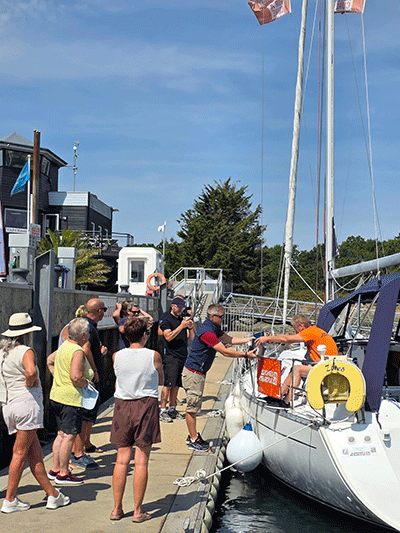 When Zēteō finally returned to Lymington, 115 days had passed since we had left. More than 2,000 nautical miles had slipped beneath her keel, Britain and Ireland were behind us, I had completed my solo circumnavigation.
People have subsequently asked me how I found spending so long sailing single-handed and I still find that surprisingly difficult to answer. It was challenging and testing. At times it was exhausting. At others it was exhilarating. There were moments of apprehension and moments of enormous satisfaction.
But perhaps the word I keep returning to is therapeutic. At sea, life becomes immediate.
The worries, distractions and ‘negative noise’ that fill ordinary life are replaced by things that actually matter at that moment: wind, tide, weather, navigation, the boat and the next safe harbour and the enormous beauty of this wonderful island we call home.
For 115 days my world contracted – and somehow became much bigger at the same time.
The voyage is finished. The challenge isn’t.
I set out to sail around Britain and Ireland. I have done that. But the real purpose of the voyage was never simply to get Zēteō back to Lymington. It was to raise money and awareness for Alzheimer’s Research UK.
Alzheimer’s Research UK exists to find a cure to this horrendous illness, funding research into its treatment, diagnosis and prevention. The charity has committed more than £171 million to dementia research since its first research project in 1998. Research is producing progress, but it requires money.
My supporters have already done something extraordinary. Together we have raised more than £12,500.
I would dearly like to turn that into £15,000.
That leaves one final stretch of this particular voyage – and unlike Cape Wrath, the Lizard or Portland Bill, this is one where I need other people to get me across the finishing line.
If you have enjoyed reading about the voyage, followed Zēteō along the way on Facebook or the countless YouTube videos I posted, know somebody whose life has been affected by Alzheimer’s, or simply think that sailing alone around Britain and Ireland for 115 days deserves a few pounds in the collecting tin, I would be enormously grateful for your support.
Every donation, however small, moves the total a little closer.
The boat is home.
The skipper is home.
Now I would just like to finish the final £2,500 of the journey.
Target: £15,000.
Raised so far: more than £12,500.
One circumnavigation completed.
One final target still to reach.
Please contribute
Paul Smith completed his solo circumnavigation of Britain and Ireland aboard his 1998 Beneteau Oceanis 321, Zēteō, on 4 August 2026, raising funds for Alzheimer’s Research UK. His voyage can be followed through his @SailingCaptainPaul YouTube channel or his Facebook Page (also SailingCaptainPaul)
Donations can be made directly on his JustGiving Page: www.justgiving.com/page/sailingcaptainpaul