






As cruising seasons become shorter and operating costs rise, yacht owners are increasingly reassessing how they move between destinations. From asset protection to reliability and sustainability, shipping is no longer seen as a last resort — but as a strategic planning tool.
For many yacht owners, the question is no longer whether they can sail their yacht between cruising grounds, but whether they should. While bluewater passages remain a defining part of yachting culture, shipping is increasingly viewed as a considered decision — shaped by time pressures, cost control, asset protection and evolving market expectations.
As ownership patterns change and seasons become more compressed, the choice between sailing and shipping has shifted from convenience to long-term planning.
Time, efficiency and asset protection
There is no substitute for the experience of offshore sailing, whether cruising between anchorages or competing on the race circuit. However, when a season draws to a close, owners must decide how their yacht reaches its next destination — and that decision carries significant operational implications.
Shipping is often the most predictable and time-efficient option. Rather than committing weeks to a delivery passage, a yacht can be relocated within a defined window, allowing owners and crews to plan maintenance schedules, travel and onward commitments with far greater certainty.
From an asset perspective, limiting unnecessary sea miles reduces engine hours, rigging fatigue and cumulative wear. Over time, this supports improved condition, more controlled maintenance planning and long-term value — considerations that are increasingly important to owners and insurers alike.
The realities of sailing or delivery voyages
 On paper, long-distance passages can appear straightforward. In practice, even carefully planned delivery voyages are vulnerable to disruption from weather systems, mechanical issues, crew availability and unforeseen costs.
Owners planning a seasonal move from the Mediterranean to the Caribbean may budget for a three-week crossing, only to find delays stretching schedules into five or six weeks once weather patterns, crew changes and maintenance requirements are factored in.
Delays increase crew and fuel costs, require insurance extensions and add mechanical strain with every additional mile. Constant exposure to saltwater also accelerates wear on onboard systems and finishes. In some regions, additional safety considerations have emerged in recent years, adding another layer of unpredictability to delivery planning. These realities have prompted many owners to reassess whether sailing remains the most practical option when schedules are tight.
While delivery voyages may appear cost-effective initially, the combined impact of fuel, logistics, insurance and potential repairs can quickly erode any perceived savings.
Why shipping is gaining ground
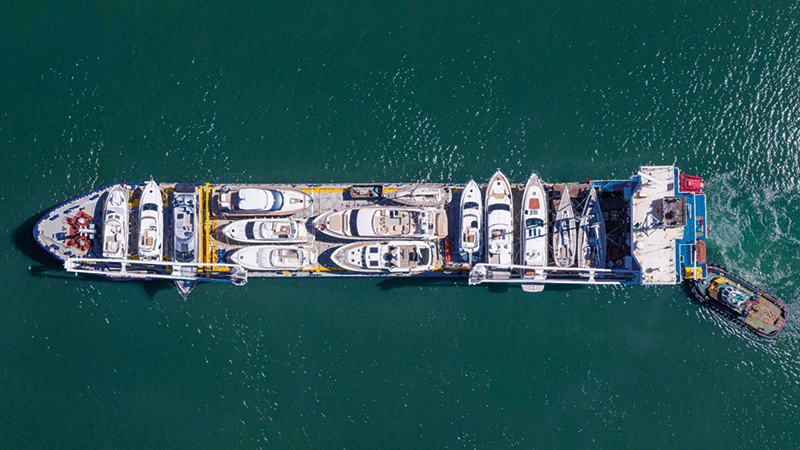
Shipping offers a managed alternative designed to reduce uncertainty and protect the yacht as an asset. By limiting time at sea, it reduces exposure to mechanical failure and adverse conditions, while allowing yachts to arrive ready for immediate use.
As Richard Howatt, UK Sales Manager at Peters & May, explains: “We are seeing a clear shift in how owners approach yacht movements. Shipping is no longer viewed as a last resort, but as a planning tool — one that allows owners to protect their asset, control schedules and reduce unnecessary risk, particularly as seasons become more compressed.”
This reflects a broader change in mindset across the market. Yachts are increasingly treated as long-term investments, with owners focusing on lifecycle management rather than simply seasonal use.
Sustainability is also beginning to influence this conversation. While yachting remains energy-intensive, reducing unnecessary delivery miles can contribute to lower overall fuel consumption and emissions over time. For some owners, shipping now forms part of a broader operational discussion that balances enjoyment with responsibility.
That said, shipping is not immune to variables. Weather, port congestion and schedule changes can still affect timings. The difference lies in visibility and planning, with managed logistics offering greater control than an open-ended delivery passage.
Understanding the costs
Cost is naturally central to the decision to ship rather than sail. Pricing varies depending on yacht size, weight, route and service type. A short Mediterranean relocation differs significantly from shipping a yacht across the Atlantic.
Additional considerations — such as cradle requirements, port handling, insurance and regulatory factors — also influence overall cost. For this reason, most owners begin with an indicative quote based on accurate dimensions, weight and preferred schedules.
Understanding the full scope of costs upfront allows for a more meaningful comparison between shipping and sailing, rather than relying on headline figures alone.
How the shipping process works
The process typically begins with route and vessel selection, taking into account seasonal demand, schedules and loading ports. Once confirmed, logistics teams coordinate documentation, insurance, port arrangements and technical preparations well in advance of loading.
On the day itself, experienced loadmasters oversee lifting and securing operations, working alongside port authorities and crew to ensure the yacht is handled safely and efficiently. Precision at this stage is critical, as attention to detail directly impacts the success of the voyage.
At the destination, offload and customs arrangements are managed to ensure the yacht is released smoothly and ready for use with minimal downtime.
A changing mindset
As the yachting market continues to mature, the decision to ship or sail is increasingly viewed through a strategic lens. Shipping is no longer reserved for exceptional circumstances but is now widely used as a planning tool to support reliability, asset protection and operational efficiency.
For many owners, the question is no longer why they would ship their yacht — but when it makes the most sense. ■