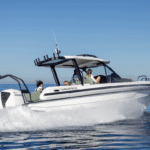

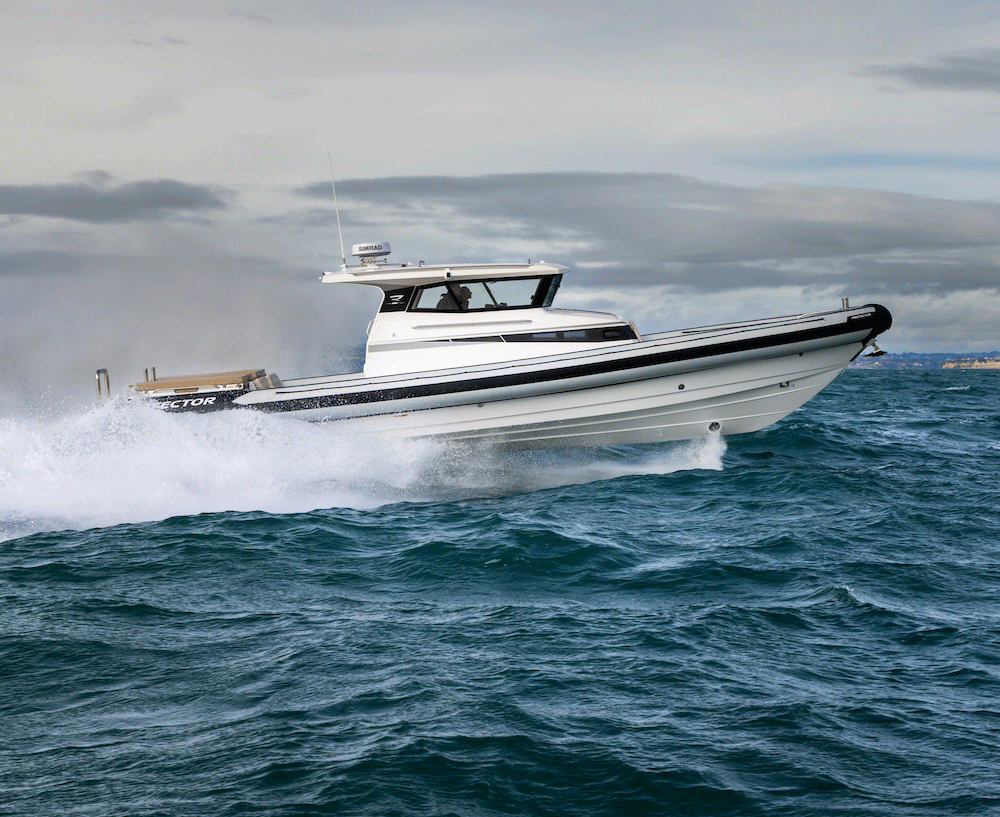
The first Protector Targa 410 Expedition has arrived in the UK, marking an important development in Protector Boats’ continued move towards highly customised, mission-specific chase boats designed around the operational demands of the superyacht sector.
Developed by New Zealand-based Rayglass Boats with the explorer superyacht market firmly in mind, the new Targa 410 Expedition combines Protector’s proven commercial-grade construction and seakeeping with greater autonomy, onboard comfort and extensive scope for yacht-specific customisation.
The vessel is also the first Protector sold by European distributor PB Europe, part of the Ancasta Group, with inboard engines. Its twin Yanmar diesel installation was specified to comply with the single-fuel policies increasingly adopted by superyachts. Now at Ancasta’s headquarters in Hamble for final fit-out and commissioning ahead of delivery, the boat demonstrates how Protector’s core engineering can be combined with PB Europe’s superyacht expertise and Ancasta’s local technical capabilities to create a chase boat around a specific yacht and its operational programme.
“This goes much further than choosing colours and upholstery,” says Andy Andrews, Sales Manager for PB Europe. “We start with what the owner and captain need the boat to achieve and configure the platform around that operational brief. The 410 Expedition demonstrates just how far we can now take that approach.”






Designed for greater independence
The Targa 410 Expedition has been developed in response to the changing role of the superyacht chase boat. As yachts undertake increasingly ambitious cruising programmes, their support craft are being expected to do considerably more than transfer guests between ship and shore. Greater range and autonomy, all-weather protection, increased storage and improved onboard facilities can allow a chase boat to support diving, fishing, watersports and expedition activities while operating independently from the mothership for longer periods.
The Targa 410 Expedition builds on Protector’s established Targa platform with a series of changes specifically aimed at these extended operations. A revised cabin and helm arrangement incorporates a distinctive inward-raked windscreen, providing improved visibility and a more protected environment for guests and crew in adverse conditions.
The cabin can be configured according to the vessel’s intended use, with options including additional refrigeration, a compact galley and bunk accommodation.
For increased autonomy, a solar power system can be incorporated to support onboard electrical systems when the boat is operating away from the yacht. Deck layouts and storage can also be developed around the owner’s programme, with options including dedicated dive racks, game-fishing configurations and bespoke solutions for watersports and expedition equipment.
“The way chase boats are being used is changing considerably,” says Andrews. “Particularly in the explorer yacht sector, owners and captains want boats that can support more ambitious itineraries and operate independently for longer. That means better protection, more storage and onboard facilities. It also means being able to configure the boat around the activities and equipment that are important to that particular yacht.”
Inboard diesel for single-fuel operations
One of the most significant specifications on the first UK Targa 410 Expedition is its twin Yanmar 8L V370s – with ZT370 Stern Drives – diesel inboard installation, replacing the outboard configuration traditionally associated with Protector craft.
For superyachts operating a single-fuel policy, diesel propulsion allows the chase boat to draw on the mothership’s existing fuel infrastructure, simplifying bunkering, storage and operational logistics. The benefit can become particularly important for explorer yachts cruising in remote regions where access to different fuel types may be limited.
“This is the first Protector we have sold with inboard engines, and it is a significant milestone for PB Europe,” Andrews explains. “For some superyachts, complying with the mothership’s single-fuel policy is a fundamental part of the specification. It is a good example of Protector adapting the boat at an engineering level to meet the practical requirements of superyacht operations.”
From superyacht brief to finished chase boat
Following construction in New Zealand, this Targa 410 Expedition is undergoing final customisation and commissioning by Ancasta’s aftersales team in Hamble. The work includes the installation of a custom composite deck and underwater lighting, alongside final detailing. Ancasta can also manufacture and install additional yacht-specific equipment in the UK, including canvas work, shades and splash protection.
The process enables PB Europe to work with owners, captains and crew to define the operational brief and specification, with Protector undertaking the core design and build in New Zealand and Ancasta providing the capability to complete bespoke elements and final commissioning close to the point of European delivery.
It is an approach underpinned by Protector’s commercial heritage. Originally engineered for demanding professional applications including police, pilot and military use, Protector RIBs provide a robust, proven platform from which increasingly specialised superyacht configurations can be developed.
“The strength of Protector is that we start with an exceptionally capable, commercially proven platform and then configure it around the owner’s requirements,” concludes Andrews.
“One captain, after taking his Protector through a particularly rough passage, told us the ‘boat was stronger than the crew’, which says a great deal about the platform we are starting with.
“PB Europe can then work with the owner and captain to define exactly what they need from the boat, Protector can engineer the solution, and Ancasta gives us the capability to refine and commission it here in Hamble. It gives us a genuinely end-to-end approach to delivering highly customised chase boats for the superyacht market.”