
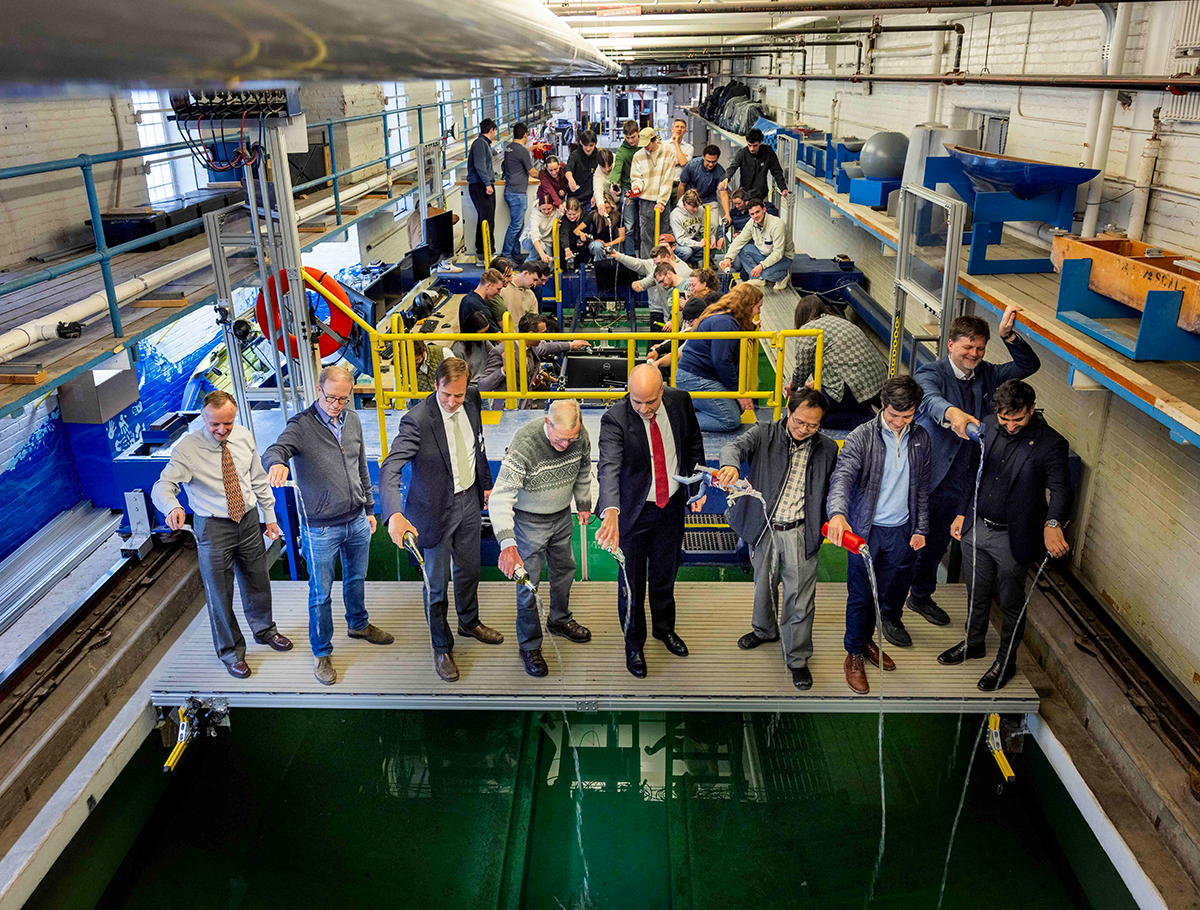
A symbolic exchange of water between the Scottish Maritime Museum’s ‘Denny Tank’ – the oldest surviving ship model experiment tank in the world – and the University of Michigan’s newly upgraded 122-year-old Towing Tank celebrates the connection between maritime heritage and cutting-edge marine research.
In keeping with the long-standing ‘Mother Tank’ tradition whereby new marine testing facilities are ceremonially inaugurated with water and ‘knowledge’ held by historic test tanks, the University of Michigan approached the Scottish Maritime Museum requesting a sample from the Denny Ship Model Experiment Tank.
The Denny Tank water, which was formally presented to the University of Michigan in a bespoke, handcrafted glass bottle, was poured into the recommissioned Towing Tank at a ceremony held at the University on 24 February.






Affectionately known as the ‘Mother Tank’ of modern shipbuilding, the Denny Ship Model Experiment Tank in Dumbarton helped shape ship design standards around the world. Located at the heart of the internationally renowned William Denny and Brothers Shipyard, it was used to test hull designs for speed and resistance and contributed significantly to William Denny’s reputation as one of the foremost innovators in shipbuilding.
Today, the Scottish Maritime Museum stands on the site of the former shipyard, which closed in 1963, with the Denny Tank at the heart.
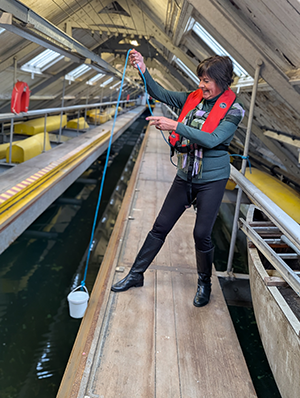
The water sample was collected by Lorna Harkin, who helped create the Denny stained-glass panel for the Museum’s Denny Social exhibition last year. The handcrafted bottle was created by Robert McLeod, Fellow of The British Society of Scientific Glassblowers, who leads glassblowing experiences at the Museum.
Jennifer Pless, Community Engagement Officer at the Scottish Maritime Museum, says: “We were thrilled to be approached by the University of Michigan and forge a link between one of maritime history’s most influential testing tanks and the next generation of marine innovation.
“Both Lorna and Robert were delighted to take part in the exchange as was the Museum team, which ensured the precious cargo was securely packaged – with characteristic Scottish practicality and humour – inside an IRN-BRU bottle for the journey to America!”
Jason Bundoff, Lead Engineer in Research at the University of Michigan’s Friedman Marine Hydrodynamics Laboratory, explains the significance of the tradition: “The lore goes that collecting water from other testing tanks helps jumpstart research. Each tank is a living reservoir of all the knowledge gained from within it. Mixing the waters from other tanks imbues the newly founded tank with all that living knowledge and helps keep that knowledge from being lost.”
Lorna Harkin reflects on her experience: “I wanted to include the glass demi-john that traditionally transferred the ‘Mother’ water from the Denny Tank to other experimental tanks as a good blessing. Being asked to collect this water sample to head to America was an amazing experience and I was so happy to be included in this little part of history that I thought was really special. I am glad we went with a smaller sample though, rather than trying to fill another demi-john!”
Background – The Denny Ship Model Experiment Tank
The Denny Tank is the oldest surviving ship model experiment tank in the world. It was constructed in 1882 at a cost of £6,000, after William Denny recognised the commercial advantage of testing ship hulls for resistance, accuracy and speed in house after using William Froude’s tank in Torquay.
Operated by a specialist team of 17 analysts, model-makers and mechanics, it was later used for tests for submarines, racing yachts, barges and the pioneering Denny Hovercraft until the shipyard closed in 1963.
Today, the Denny Tank is the centrepiece of the Scottish Maritime Museum’s Dumbarton collection, complementing the Museum’s collections in Irvine, North Ayrshire. In 2023, the Tank was awarded a ‘Red Wheel’ by the National Transport Trust recognising it as one of the UK’s most important transport heritage sites.
The University of Michigan Test Tank
The University of Michigan’s newly upgraded, 650,000-gallon Towing Tank is a leading facility for hydrodynamic model testing, supporting the design, build and testing of maritime systems.
Located in the West Hall (formerly West Engineering), the tank, which measures 22 feet wide, 360 feet long, and 12 feet deep, will help drive innovation in the naval, maritime, and offshore sectors.