
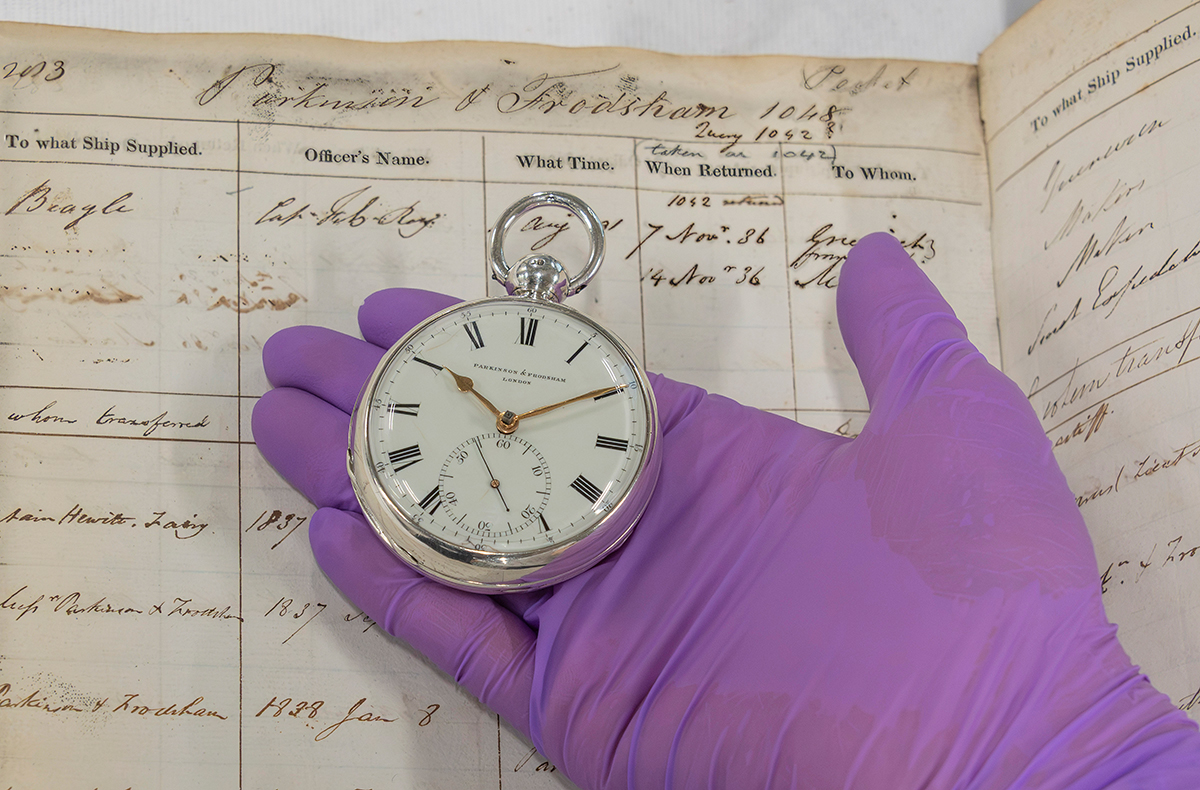
The National Maritime Museum, Greenwich has acquired a rare pocket chronometer – a timekeeper used on ships to determine longitude while navigating at sea – known as ‘K’. It is one of only two surviving pocket chronometers from the Beagle Voyage (1831-1836), the expedition during which Charles Darwin carried out research leading to his theory of evolution.
The instrument was saved for the nation following an export bar in 2025 and will go on public display at the National Maritime Museum, Greenwich in October 2026.
HMS Beagle set sail to survey the coasts of South America, but the voyage is now most famous for the research carried out by Darwin. During the expedition, he collected specimens, recorded observations and sketched the flora and fauna he encountered. This work later became evidence for his groundbreaking theory of evolution.




Robert FitzRoy, captain of the Beagle, took 22 chronometers on the voyage. He selected ‘K’ as the observation chronometer and referred to it affectionately as the ‘journeyman watch’. Whilst most of the chronometers remained secure in the captain’s cabin, FitzRoy took this pocket watch on shore to measure the celestial observations essential to his timekeeping measurements. He describes it as ‘a very good pocket chronometer, carried by hand, in a box, [and] was always used for taking time’ on shore.
Charles Darwin wrote of the chronometers that ‘There is a most important error in the longitude of S America, to settle which this second trip has been undertaken. Our Chronometers at least 16 of them, are going superbly: none on record ever have gone at all like them’. The Beagle returned after the five-year journey and Captain FitzRoy reported an error of only 33 seconds in the chronometric calculations, despite only 11 of the chronometers functioning fully on their return.
Funded by the Admiralty since 1818, the Royal Observatory, Greenwich played an important role in the management and testing of Royal Navy chronometers in this period. The Astronomer Royal, John Pond, reported on the best instruments and these were reserved for the Beagle voyage. Francis Beaufort, the Hydrographer of the Navy – the officer responsible for the production of charts – specifically requested pocket chronometer ‘K’ for use on the voyage.
The Royal Observatory still holds the ledger books in which staff recorded the sea lives of these chronometers. As Admiralty hydrographers surveyed the globe, they relied on these timekeepers for measuring locations relative to Greenwich. Decades later, the widespread use of these British charts based on the Greenwich meridian contributed to its designation as Prime Meridian of the World (0° longitude) in 1884.
The chronometer was acquired following a successful fundraising campaign with support from Art Fund, Society for Nautical Research, The Tanlaw Foundation, National Heritage Memorial Fund and private individuals.
Paddy Rodgers, Director, CEO, Royal Museums Greenwich, said: ‘This is a lovely object, with beauty and functionality, which sits at a lovely intersection between navigation, Darwin’s emerging science of evolution, and FitzRoy’s emerging status as a pioneer of meteorology. The charting of the globe with the Greenwich meridian at its centre, the understanding of evolution, and the mapping of weather systems are all cross-referenced by one very special timepiece. What a treasure!’
Ruth Mackenzie, Arts Minister, said: ‘This remarkable chronometer is a reminder of the stories held in our national collections, and of Britain’s contribution to science, exploration and maritime heritage. Its connection to HMS Beagle and Charles Darwin’s historic voyage makes it an object of outstanding cultural significance.
‘I am delighted that, thanks to the export bar system and the generosity of supporters, this important piece of our shared heritage has been saved for the nation. I look forward to seeing the chronometer when it goes on display at the National Maritime Museum in Greenwich.’
Jenny Waldman, Director, Art Fund, said: ‘This remarkable timepiece holds fascinating stories about Charles Darwin’s expeditions and is a wonderful addition to the nation’s collections. We’re delighted to support the National Maritime Museum in acquiring this unique object and we’re grateful to our National Art Pass members, who make our support towards acquisitions like this possible. We look forward to seeing the chronometer go on public display in October, where it will inspire and fascinate visitors now and for generations to come.’
Professor Claire Jowitt FEA FRHistS FHEA, Chair, Society for Nautical Research, Society for Nautical Research, said: ‘The Society for Nautical Research is pleased to have played a part in securing the future public display of this chronometer from HMS Beagle’s second survey voyage. Some artefacts have the ability to sum up key moments from history: this circumnavigation was not only significant for the development of Darwin’s ideas about evolutionary biology, but its chronometers established for the first time a linked chain of reference points around the globe of known longitude. We are delighted that the National Maritime Museum, Greenwich can now share this important heritage with the nation.’
Lord Tanlaw said: ‘The Tanlaw Foundation are delighted to contribute towards retaining this important HMS Beagle chronometer for the nation.’
Simon Thurley, Chair of the National Heritage Memorial Fund, said: ‘This rare pocket chronometer is a remarkable link to Charles Darwin’s voyage on HMS Beagle and the careful navigation that led to the transformation of our understanding of the natural world. It is also a shining example of the UK’s leadership in navigation during the 19th century and helped lay the foundations for the international acceptance of Greenwich as the Prime Meridian in 1884. We are therefore delighted to support Royal Museums Greenwich in securing it for the National Maritime Museum, where it can be protected, researched and shared with the public. The Memorial Fund exists to save the UK’s most outstanding heritage and make it publicly accessible, in memory of those who have given their lives for the UK. I am pleased that we have been able to help save this extraordinary instrument, so that future generations can continue to learn from and enjoy it.’