

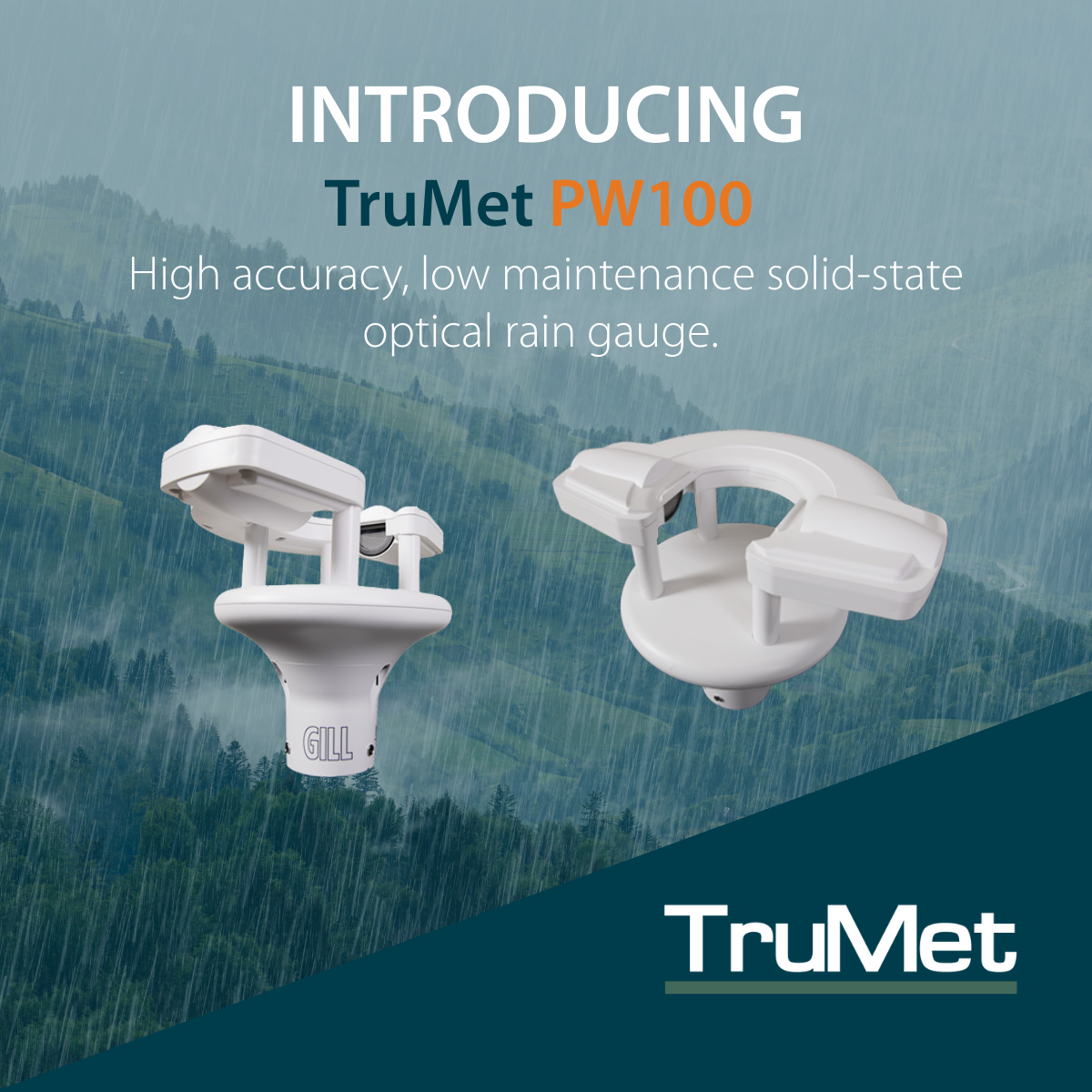
Gill Instruments, award-winning designer and manufacturer of meteorological and environmental measurement instruments, has announced the launch of TruMet PW100, its new infrared optical rain gauge.
For decades, rainfall measurement has relied on mechanical tipping bucket gauges. While trusted, these systems are prone to clogging, mechanical drift (requiring frequent calibration for reliable data), and under-counting during high-intensity rainfall, leading to maintenance demands and data uncertainty when accuracy matters most.
Gill’s TruMet PW100 Optical Rain Gauge is meticulously engineered to overcome these long-standing challenges, ensuring true reliability and precision.





A new approach to rainfall measurement
The TruMet PW100 uses a solid-state optical measurement principle rather than mechanical collection. LEDs (light-emitting diodes) create a beam of light across a defined sensing area, and a receiver monitors interruptions in the beam caused by rainfall. By analysing the size and velocity of droplets, the system accurately measures rainfall accumulation and filters out non-rain interference, such as insects or debris. With no moving parts, collection funnel, or tipping mechanism, the infrared optical rain gauge delivers accuracy equal to that of traditional tipping buckets, but without the mechanical parts that can fail, reducing maintenance and long-term costs.
Designed for modern monitoring challenges
The TruMet PW100 provides reliable rainfall measurement at a lower lifetime cost, with less complexity or servicing than traditional or specialist instruments.
Typical applications include:
- meteorological and hydrological networks
- flood forecasting and early-warning systems
- smart city and urban drainage monitoring
- transport, aviation and infrastructure operations
- renewable energy and environmental monitoring
By minimising routine maintenance, the TruMet PW100 Optical Rain Gauge lowers ownership costs and improves data reliability for widely distributed networks.
Engineering confidence from Gill
“Rainfall is changing, yet the industry relies on legacy mechanical technology,” said Greg Koch, Product Manager at Gill. “We didn’t set out to reinvent rain measurement for novelty’s sake. We set out to remove the weakest link. This optical rain gauge delivers trusted accuracy without moving parts and minimal maintenance, which fundamentally changes how rain data can be collected at scale.”
Seamless integration with existing networks
At launch, TruMet PW100 Optical Rain Gauge outputs the standard pulse signal (an electronic output used by weather equipment) that tipping bucket rain gauges use, so it can be deployed as a direct replacement within existing monitoring networks without system changes or retraining. Software and hardware updates will further expand the optical rain gauge’s capabilities and data options.
The TruMet PW100 Optical Rain Gauge will be available both as:
- a standalone rainfall sensor, and
- an integrated option within Gill’s MaxiMet product line, including the upcoming GMX603, which incorporates the optical rainfall technology into a compact weather station (an instrument that measures multiple meteorological parameters) for best-in-class meteorological monitoring in a single instrument.