
On 20 June in London, 80 dinghies raced ten miles up and down the River Thames as part of the Tideway Dinghy Derby supported by Laing O’Rourke, celebrating a cleaner tidal Thames and supporting a life-changing sailing programme for young people.
It’s been a long, long time since this race was last held. 1977 in fact when 300 boats took part during the Queen’s Silver Jubilee. Many more would have liked to race this year, but the Thames is a far busier place nowadays, and getting this event off the ground has been a gargantuan effort by Ranelagh Sailing Club with an immense amount of support and goodwill from the Port of London Authority.
It’s not often British megaprojects are lauded, but the Thames Tideway Tunnel really is astounding. The network of tunnels underneath London is already complex enough with the various underground trains and much more besides, so finding the space for a 25 kilometre long tunnel, big enough to fit three double-decker buses side by side, has been challenging to say the least. Couple that with the fact that it goes directly under some of the best-known landmarks in the world, such as Tower Bridge, and the geology changes continually, and it has to be regarded as a modern engineering marvel.




The reason it’s less celebrated than many more visible projects is that it’s actually a sewer – not the most glamorous subject, and definitely something people would prefer to ignore. The upside is that the River Thames is now cleaner than it has been for hundreds of years, making it a habitat once again for marine life like seals and porpoises and also for sailing. In its first year of operation the Tideway Tunnel has diverted over 18 million tonnes of storm sewage away from the River Thames.
The race itself heads downstream to a turning mark just off the Houses of Parliament, past many iconic landmarks such as Battersea Power Station, the Secret Intelligence Service building (MI6), made famous in a number of James Bond films, and a number of historical bridges.
Ranelagh Sailing Club sits on the Putney Embankment, surrounded by the boathouses of the rowing clubs, with Fulham Palace just across the river. Being London, there’s always something going on, and on Saturday morning the rowing teams, a running event, cyclists and cars were all jostling for position and weaving their way between the myriad of dinghies rigging ahead of the race.
The fleet was separated into four starts with the Fireflys off first at 11.30, then at five minute intervals two handicap fleets set off, with the Merlin Rockets starting at 11.45. Both the Fireflys and the Merlins are celebrating their 80th anniversaries this year, and are enjoying strong turnouts; the excitement to compete in such a historic race was evident. The dinghies ranged from classic river designs, including the first-ever Merlin ‘Kate’, all the way to the latest Rockatross Merlin, with all the other fleets seeing boats old and new taking part.
Starting was a challenge, with the strong ebb tide and light winds making it difficult to stop being pushed over the line. Most chose to face upstream until the final seconds, while a few brave sailors went for it with a timed run at pace towards the line.
In no time the fleets had tacked their way towards Putney Bridge, anxiously looking up at their clearance while handling the inevitable gusts from all directions in an enclosed space. Within a moment they were under Fulham Railway Bridge, past the exclusive Hurlingham Club, and on to the bend in the river at Wandsworth Bridge.
The Port of London Authority vessels and Ranelagh support boats were making sure they were taking the correct bridge arches, to keep clear of other river traffic, while overhead helicopters regularly passed, taking off and landing at London Heliport, conveying the rich and famous to Royal Ascot.
Then came the turn east at Battersea Bridge, with the fleet challenged by the ever-changing wind direction, then quickly under the wide Grosvenor Bridge with its nine active railway lines, quickly past the renovated Battersea Power Station (now a massive shopping centre, luxury apartments and extensive office spaces) onto the next bend north and the Vauxhall Bridge, with its eight allegorical statues representing British creativity and industry: Architecture, Agriculture, Education, Engineering, Fine Arts, Local Government, Pottery, and Science.
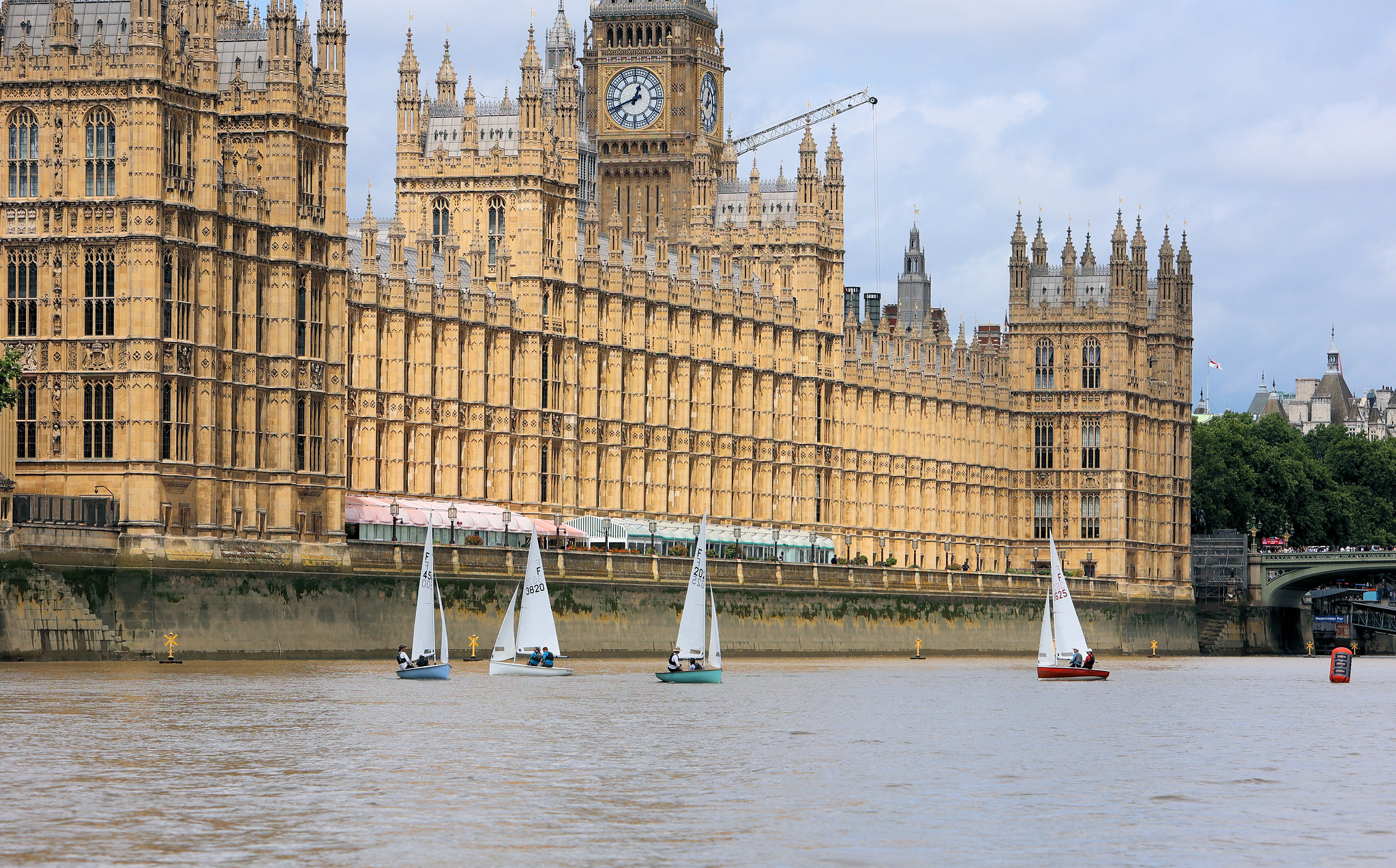
After the MI6 and MI5 buildings the fleet was soon under Lambeth Bridge with its sweeping arches, and on to the rounding mark of the Houses of Parliament. Officially called the Palace of Westminster, this is the literal and symbolic heart of British democracy and one of the most iconic and recognisable buildings in the world.
I’d seen grainy photos of previous editions of the race, as well as a British Pathé film of the 1962 edition of the Derby, but having the chance to photograph the fleet 49 years on from the last running of the event was incredible.
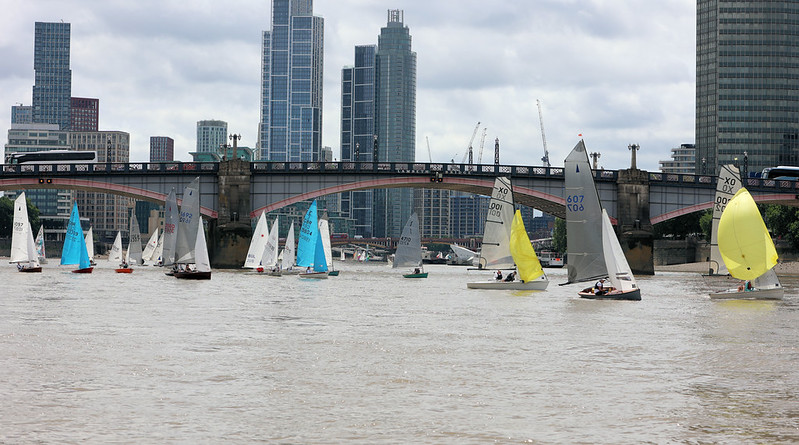
The tide hadn’t turned by the time they reached the turning point, which meant the majority of the dinghies remained bunched together between Westminster and Lambeth bridges for quite some time. I’ve been reliably told it was extremely hard work for the crews, jostling for position and trying to connect the gusts of wind together, while also trying to hug the shoreline, but from my point of view it was a dream to have so many boats in shot at the same time.
Moments like this don’t come around very often, and I felt very lucky to be witnessing it. I’m sure the sailors are still buzzing about the moment, and the competitors’ Whatsapp chat attests to it. Everyone knew that they were part of a truly historic moment.
Despite this inevitable compression in the fleet, a few boats did manage to get away from the melee to progress up the northern shoreline. The Fireflys are particularly adept at short tacking, which is what makes them so suitable for team racing, and were demonstrating this ably close the bank, together with a few classic Merlins, which were specifically designed for river sailing.
Angus Cook and Lucie Hopkins led the way in Firefly 3695 ‘Officer Dibble’, eventually overtaken on the water by Merlin 607 ‘Crescendo’ of Andy Harris and Sara Warren. This Merlin is a Prelude design, built by Jack Holt in 1955 on the Putney Embankment, so was very much at home on the Thames.
Once the tide started to turn, the fleet sped their way back towards Putney and the Ranelagh Sailing Club finish line, each greeted by a ring on the bell from the club balcony.
The overall results were dominated by the Fireflys, taking nine of the top ten places, with Angus Cook and Lucie Hopkins taking the overall win, then Roger and Amy Morris second, followed by Nigel Wakefield and Emily Saunderson third.
Val Nevikov won the Low Handicap fleet in an ILCA, while Andy Harris and Sara Warren held onto first place in the Merlin Rocket class.
It was fantastic to see Greig City Academy’s Corneille Leprince finishing ninth overall in his ILCA 6, also winning the High Handicap group and the youth sailor prize. Corneille is one of the many protégés of the sailing programme set up by inspirational teacher Jon Holt, who has turned an inner city school into a hotbed of sailing talent. In a breakthrough moment for diversity in sailing, Corneille has recently been selected for the British Sailing Youth Team.
It was back in 2015 that the school bought the 45-foot racing yacht ‘Scaramouche’, going on to compete in the Fastnet Race in 2017 and again 2019. The Scaramouche Sailing Trust was also established as a charity in 2019, with Greig City Academy sailors now going on to great success in world championships, and alumni Kai Hockley becoming part of the Emirates Great Britain SailGP team.
The Tideway Dinghy Derby has already raised thousands of pounds for the Scaramouche Sailing Trust, which will help the next generation of sailors come through. Jon and the team have learned a huge amount on what it takes to run a successful school sailing programme, and are giving advice to other academies as to how they can build their own, giving more young people the opportunity to sail and enjoy life on the water.
We were joined on the water by Fleur Anderson, MP for Putney, who was so inspired by the race and the young Greig City Academy sailors taking part that she is now actively looking at supporting schools in her constituency to get out on the water and follow the lead that Jon and the Scaramouche sailors have set.
Prizes were handed out by Vendée Globe star Pip Hare, who also sailed in the race with Elayra from the Greig City Academy girl’s team in a 2000. For Pip it was her first dinghy race in 15 years!
I also got to judge the Concours d’Elegance together with Greig’s Loreto, who ably handled interviews with sailors and filmed much of the race alongside me. Later in the week I’ll be producing a video with this footage. There were so many stunning dinghies taking part that it wasn’t easy to select a winner, but we chose the first-ever Merlin ‘Kate’, which was constructed in 1944 by a syndicate of eight Ranelagh Sailing Club members as an experimental, affordable, and high-performance racing dinghy. The name was derived from the last four letters of the word ‘syndicate’. This boat is a true piece of sailing history, and it’s great to see her so beautifully restored and actively sailing.
Huge thanks to all who made this race possible: Richard Westover and the team at Ranelagh Sailing Club, together with the support and understanding of the Port of London Authority, the sponsorship of Laing O’Rourke, and the many volunteers made this an occasion to remember.
The demand is incredibly high for this to be made an annual event, and the capped entry of 80 boats was massively over-subscribed, so hopefully everyone can come together again to make it happen. This wasn’t just a celebration of the new ‘super sewer’, or the fact that the Thames is so clean, or even the inspiring Scaramouche Sailing Trust – this was a celebration of everything that is good about sailing itself – its past, present and future.
The Tideway Dinghy Derby is quirky, demanding, frustrating and rewarding in equal measure, but everyone came off the water inspired.
If you feel similarly inspired reading this and seeing the photos, then please do make a donation to the Scaramouche Sailing Trust through their website at scaramouchesailing.org.uk . What they are pioneering is the future of sailing itself.
By Mark Jardine